Showing posts with label long labor. Show all posts

Wednesday, August 14, 2013

Childbirth Choices Series Part III: Do I Need a Doula?

This is the third in my Childbirth Choices Series, geared toward newly pregnant or planning-to-be pregnant couples with the goal of educating women and their partners about the many options they have when it comes to their prenatal and maternity care, including choosing a care provider, choosing where and how to give birth, and information about labor, delivery, and the immediate postpartum time. This is not meant to replace or substitute for a childbirth education class. Rather, it is intended to get women thinking about their options and making informed choices when it comes to their care throughout pregnancy and labor and delivery.

More articles in this series:
Part I: I've Just Found out I'm Pregnant; Now What?
Part II: Meeting Your Care Provider
Part IV: What Will Happen at My Prenatal Appointments?
Part V: It's almost Time to Have a Baby!
Part VI: Labor and Delivery
***
Sometime reasonably early in your pregnancy, perhaps in the first part of the second trimester, you'll want to start thinking about who will be there at your birth. For many women, it's a no-brainer: the father of the baby should attend the birth. For others, the father may not be present, there may be no "father" in a parenting sense, or the father may not be able to attend due to circumstances out of his control, such as being deployed with the military. In other cases, the pregnant woman's partner may simply feel inadequate to be fully supportive or may be unwilling to try. Other partners may simply feel that having someone else there who knows what labor and childbirth should look like may be helpful.

That's where a "doula" comes in.

Realistically, it's only in the past maybe 40 years that the father of the baby has been expected to be anywhere near the birthing room. Birth, historically, has been the domain of women. A laboring woman's mother, older sisters, aunts, or other women in her life who have been through childbirth would traditionally attend her, as would a trained midwife, typically. Even when male doctors started attending births, fathers waited outside. Today, most fathers desire to be in the birthing room, supporting the mother of their child and meeting their new baby right away, and most new mothers want the father to be there.

In all cases, there is no question that a woman was never expected to get through labor alone. 

The word "doula" comes from the Greek meaning "a woman who serves." Today, the term doula generally refers specifically to a woman (or occasionally a man) who attends a woman during her labor, providing physical and emotional support, helping her understand the birth process and what's happening to her, assisting her in communicating with her partner and her care providers, and helping her to make informed decisions throughout the labor and delivery process. The term doula is a professional title for someone who has been trained in this arena, but in terms of the more casual use of the word, a doula is anyone a woman chooses to be there to support her as she labors. 

It is important to remember that a doula is not a medical provider. A doula does not check vital signs, administer medications, check cervical dilation, or make recommendations or medical decisions on behalf of the mother, and she does not deliver the baby. A doula is a support person who understands the birth process and can help the laboring woman manage pain using non-medical techniques such as breathing and relaxation. Some doulas have specific training in areas such as massage, aromatherapy, or acupressure that she can use to offer other types of relief as a woman labors. A doula's primary role is to provide information and emotional and physical assistance. A doula is in constant attendance and is there solely for the sake of the mother.

Why Might You Want a Professional Doula?

While anyone can technically act as a "doula," such as your mother, sister, or best friend, a professional doula will have specific training in how to support a woman in labor. She will have knowledge and an understanding of the birth process. She will be a steady presence, someone who has seen birth and knows what's going on who can offer perspective, information, and help the mother make informed decisions when presented with choices by her care provider. She can help the mother and her partner develop a birth plan or decide on birth preferences and come up with alternatives in case of unexpected events. A professional doula, more than anything else, will be a source of reassurance and strength during this exciting and frightening event and will act as a mother's advocate in the medical setting, and she will be able to be with the laboring mother at all times, while the medical personnel are generally in and out over the hours. A doula can also support the laboring woman at home and help her decide when it is time to go to the hospital, enabling her to spend more time in the comfort of her home and not set off in a panic to the hospital the moment the first contraction hits.

Professional doulas have specific training and are required to attend several births before receiving their doula certification. Doulas are certified by DONA International and may use the initials CD(DONA) after their names. See www.dona.org for more information about DONA and how doulas are trained and certified.

Why Might You Not Want a Professional Doula?

Not everyone has a doula at her birth, and not everyone wants one. You may feel that you know enough about the birth process, or you trust that your partner or another family member or friend will be sufficient support that you don't want or need to seek out a professional. For many, there are also financial considerations. While most women who have had a doula at their birth will tell you it is money well spent, a professional doula typically charges anywhere from $700 to over $1,000, depending on her services, experience, and your region, and this is generally not covered by insurance. Finally, some women or their partners are uncomfortable with the idea of having essentially a stranger attending such an intimate experience in their lives, or they feel that one more person in the room will be one more too many.

I should note that if finances are the main reason you are not considering hiring a doula, you can often find doulas who are willing to work with you on a payment plan, as well as doulas-in-training who may be willing to negotiate a reduced fee. There are some doulas who donate their services on occasion, depending on the circumstances, and there are some hospitals (a few) that may have a volunteer doula program where doulas will attend your birth at no additional cost to you. The disadvantage to this last option is that you wouldn't get to meet her in advance and become comfortable with her. Please remember that for a professional doula, attending births is her job as well as her passion, and she will be spending many, many hours with you as you labor, often through the night, both at home and in the hospital or birth center, and it is not fair to expect her to do it for free.

If your major concern is the idea of having a stranger with you, keep in mind that you will meet with your doula a few times before you go into labor, and you should only choose someone that you feel comfortable with. Your care provider and the nurses who attend you (if you deliver in a hospital) will also be relative "strangers" as well, if you think about it.

Many women do not hire a doula either because they don't know it's an option that exists or because it seems too "hippie" and nontraditional. Women who choose to have a doula attend their birth are still a small percentage of all birthing women, but the number is growing. Studies have shown that women who have a doula with them at their birth report more positive feelings about their births, shorter labors, and healthier outcomes for mother and baby. 

Thoughts from Two Professional Doulas

I interviewed two professional doulas to get their perspective on what their role is. Jenna Anderson and Jessica McGuire are San Diego-area doulas who were kind enough to participate in the writing of this article. 

Jenna and Jessica were both inspired to become doulas after the births of their first babies. Jenna did not have a doula in attendance, but after the long labor she realized how helpful it would have been to have another support person as she labored, especially so that she wouldn't have been left alone through so much of the labor process. She decided that she would like to become a doula to provide that kind of support to other laboring women. Jessica did have a doula with her at her first birth. Though she found her birth to be quite traumatic, she reports that her doula was very encouraging and reassuring as labor progressed. She remembers a line from More Business of Being Born that said that doulas are natural born teachers and realized that this was her calling.

I asked Jenna and Jessica to describe, in their own words, what a professional doula does. They both responded that their role is to provide information, support, encouragement, reassurance, and advice to the laboring woman and her partner. Jessica stressed that her advice should never be unsolicited and both Jenna and Jessica stated that they adjust their role and how hands-on they are based on the needs of the individual woman they are with. 

I then asked what they are not supposed to do. Both mentioned that they specifically cannot and do not speak for the mother, nor can they provide any clinical or medical services such as cervical checks or fetal heart monitoring. They both again stressed that their role is support, information, and reassurance.

Jenna and Jessica described some of the methods they use to help a woman relax and cope with contractions. They may use essential oils, massage, hot water bottles at specific points on the body, and they may suggest different positions and movements and, of course, offer verbal encouragement and emotional support. Jessica also mentioned that she has received certification in the use of a TENS unit to help with pain management.

Jenna's website is thebirthofadoula.blogspot.com and Jessica can be found at www.agapebirthandbeyond.com.
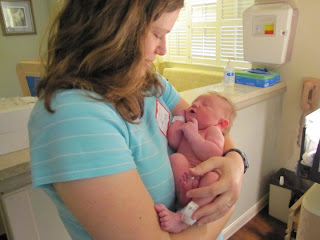


I acted as a doula at the birth of my friend's second child a few years ago. You can read my account of that incredible event here.


More articles in this series:
Part I: I've Just Found out I'm Pregnant; Now What?
Part II: Meeting Your Care Provider
Part IV: What Will Happen at My Prenatal Appointments?
Part V: It's almost Time to Have a Baby!
Part VI: Labor and Delivery

Monday, August 20, 2012

Lynne's Birth Story - Jessica's Birth!

This is a very, very special blog post, written by my mom, about my birth and her breastfeeding experience with me. I'm struck both by how many similarities there are to giving birth 30+ years later, and also by what was different. Much of this should seem familiar to those of us who have had hospital births. There was far less breastfeeding support back then, but many of the challenges my mom faced are the same challenges faced by working women today. There wasn't much on the books at the time for breastfeeding mothers in the Navy, but my mother made her own rules! I hope you can see where I get some of my passion from in reading my mother's story.
-------------


I really don’t remember why I decided that my baby would be born naturally and I would breastfeed. I’m the type of person who, when confronted with a new situation, will spend hours researching and reading, so it is possible that when I found out I was pregnant nearly thirty-two years ago, I rushed out and purchased as many books (no Internet) as I could find on childbirth and breastfeeding. I was greatly influenced by a book called The Immaculate Deception, by Suzanne Arms, published in 1975, which described the horrors of modern childbirth. I still have a copy of the book.  [Ed. note: This book is now out of print, but apparently the author wrote a second one: Immaculate Deception II: Myth, Magic and Birth, in 1994.]

Natural birth was becoming the “rage” in the early '80s, with hospitals opening up “Alternate Birth Centers” called “ABC rooms,” so I’m sure I was influenced by this trend, but there could have been other women in my life at the time who influenced me. As I said, I don’t remember. I do know that I wanted the very best for my baby, that she (I didn’t know it was a girl until she was born – no regularly-scheduled ultrasounds then) would have every benefit I could give her as she came into this mean, cruel world. I wanted her to be perfect.

I was (and I guess still am, but with less energy) a perfectionist and was not afraid of challenge or hardship, as I tended to push myself over the limit in everything I did. I was also extremely stubborn and tended to believe that if I wanted something, I would get it, so being an officer in the U.S. Navy at the time did not seem an obstacle to fulfilling my goals for my baby.

My pregnancy wasn’t anything interesting except for my high blood pressure, which the doctors passed off as nothing since it didn’t get any higher from my first prenatal visit. I gained more weight than I should have and I tended to eat a lot of chocolate but I exercised and did yoga. I expressed my desire for a natural birth and wrote up a “birth plan” to present to the attending doctor when the time came.

I worked passed my due date without a problem. That weekend, we went to a Triple A baseball game and fireworks at the stadium (the major leagues were on strike that summer). My water broke in the middle of the night and we called the hospital. They said to come right in. I knew that was a mistake; that I needed to stay home as long as I could and walk, walk, walk but I was also scared that something could happen with my water breaking so we trudged to the hospital in the middle of the night. I was only one centimeter dilated. They said that they preferred that I stay, because my blood pressure was high (no kidding), and I had signs of preeclampsia and a chance of infection, and we were too many miles away from home to turn around. I was admitted to a ward but I didn't want to just lie there, so my husband and I walked around the hospital campus for a while. I was hurting and scared and knew that I was starting out on the wrong foot, but I presented my birth plan to the resident. The poor guy; it was early in his rotation to OB, and he wanted to do well but was inexperienced, which is probably why he agreed to my birth plan. It included no drugs and no IVs or monitors so I could move around. I was hooked up to the monitors once an hour but was free to walk around the rest of the time. Ideally, when the contractions started and I was well on my way, I would gather my strength and all that I had learned from the myriads of reading materials and move around. Alas, I didn’t. I lay there for hours on my back, enduring the pain, which I could not believe was so bad, ignoring the breathing techniques we learned in our Bradley classes, but still determined to avoid drugs. I did not have an IV and did not drink anything, so I became dehydrated and the baby also. The doctor would come in periodically and check on me. He felt sorry for me and would induce a semi-trance to help me, which wasn’t helping since it reinforced me lying still for so long. My husband came and went, bored and scared.

The doctor did talk to me about a cesarean as my labor wasn’t progressing as quickly as it should have, but I declined. After twenty-six hours, on Monday morning, I was finally ready to push. I was transferred from the labor room to the delivery room. My husband was prepared with his camera but he had forgotten to put film in (no digitals then) so we don’t have a record of the birth. I pushed and pushed but the baby wasn’t coming out so the doctor took up his scissors (or whatever they were) and did the longest and deepest episiotomy on record (at least it seemed that way to my husband who nearly fainted, equating the sound to tearing a chicken wing in half) without asking. I had also been doing exercises to avoid an episiotomy but I guess they didn’t help. The baby slid right out amid a lot of blood and it was announced that it was a girl. I asked to have her on my chest and see if she would latch on but since her Apgar scores were too low, they let me have her for less than a minute and rushed her off to the neo-natal ICU. Not part of the plan but I was exhausted at that point.

I went to recovery and had to pee 1,000 cc’s before I could go to the ward. I requested that I be discharged as soon as possible, that I didn’t want to stay in the hospital. I had it in my mind to take the baby home right away, as I wasn’t sick and therefore did not need to be in the hospital. When the pediatricians visited, I told them I was going home and taking the baby with me. They said I could go home but the baby was in the NICU and wasn’t going anywhere. They had come to consult with me about her condition. She was extremely dehydrated and had “thick blood”. Her white cell count was elevated, suggesting an infection. They needed to take out half her blood and replace it with plasma because it was too thick to travel her veins and she was headed towards major brain damage if nothing was done, all because I wanted a natural birth, but I was stunned from the pain and the contractions into a trance and my doctor was too ignorant to compensate for the lack of modern intrusions like the IV for hydration.

I went home eleven hours after giving birth; the baby didn’t. I visited daily, tried to pump and tried to breastfeed her when they would let me, but they convinced me to start her on formula so she didn’t lose any weight so I agreed. She developed jaundice and spent five days in the NICU altogether before she was released. Luckily, she recovered completely.

I was still determined to breastfeed and started immediately. No one told me that babies can’t switch from formula to breast milk smoothly. She was up the entire night crying and pooping, crying and pooping. I knew nothing about the proper latch so every time she latched, I’d literally cry out for the pain. We finally settled into a routine and I tried to pump in between feedings (huh, she wanted to nurse all the time) in preparation for going back to work. I had six weeks off and decided to stay home full time for four of those weeks and return part time for four weeks, which was approved by my command.

I needed to pump and store the milk at work. I marched into my commander’s office and announced that I needed a private office so I could pump. It never occurred to me that he’d disagree; I was that sure of myself. He never said a word and I pumped until the baby was four months old and then had to start “supplementing” with formula as I couldn’t keep up with her demand. She nursed at night until nine and a half months and then stopped altogether, probably because I didn’t have enough milk.

In a way, that inexperienced doctor with a heart of gold did me a favor by not performing a cesarean, as there were no such things as VBACs then and I would have probably not breastfed (although I don’t really know), but there was also the real possibility of damage to my little girl because of my shock when labor actually came.

I learned a lot with her and knew a lot more when my son came along three years later. But, of course, my daughter is perfect!

Tuesday, July 17, 2012

Pain (and Pain Relief) in Labor

I love reading birth stories. They're incredibly cathartic, emotional, thrilling, even the "boring" birth stories. In fact, I wish everyone a "boring" birth story, because no excitement means no complications and no scary situations! So whenever a friend has a baby, I wait anxiously to read or hear her birth story, because I want to share the experience with her, to empathize, sympathize, commiserate, and celebrate with her. Reading other birth stories lets me understand my own births in a broader context, gives me insight into how other women perceive and experience birth, and demonstrates the attitudes of other practitioners and other facilities.

In reading a birth story the other day, I was amazed by how often she mentioned the pain, how she couldn't wait to go to the hospital and get the epidural, and how she mentioned the agony and doubling over and how excruciating it was. Now, I've given birth three times, and, yes, it hurts. A lot. No question. But she seemed so focused on the pain, so obsessed with getting the pain over with by getting her epidural.

I totally understand. I really do. Birth is intense, contractions sometimes feel like they're never going to end, and pain trumps reason. And when I had my first baby (as this was her first), I'm pretty sure I was quite focused on getting to the hospital and getting the pain over with.

I don't mean to belittle her experience. Indeed, some women experience pain more acutely. Some women have lower pain tolerance than others. And I'm sure that some women experience contractions as more painful or have more intense contractions than others. And reading her story, it sounds like her water had broken and was slowly leaking over the course of several days, and I well know that contractions without the bag of waters intact are far more powerful and intense than those that are cushioned by the amniotic sac.

All of that said, the reason I bring it up is this: I think that if you fear the pain of labor, or if you are focused on when you can have relief from that pain, the more painful you will perceive those early labor contractions to be. And if those early ones are "that bad," how much worse will the later ones be?

Again, labor is painful for most women. There's no getting around that. But there's a psychological element to pain, and I think that's where childbirth classes and preparing for labor and getting your head in the right place can really make a difference. There are many techniques out there for handling labor without medications. There's the well-known Bradley and Lamaze methods. There's Hypnobirthing. You can take classes or read books or listen to podcasts to learn about these methods. But even if you don't use a specific method (as I didn't), you can still prepare yourself emotionally and psychologically to expect and handle the contractions and associated pain.

Even with my first labor, I felt some obligation to delay the epidural for some time. I don't remember why, except that, even then, the limited knowledge I had was enough to know that getting the epidural too early can cause problems. As it was, I got it far too early, at only 4cm dilation. It probably would have been smart to be mobile longer in that birth, although there's no way to know if I would have been able to give birth vaginally to my large-headed, OP child. I do remember that I opted for the narcotic pain relief first, so that I could delay an epidural, even though I had been in active labor for quite a few hours by then and was very tired of it.

My self-education after that birth led me to consciously delay the epidural even longer with my second birth. I think knowing pain relief wasn't something I could have made me willing to work through the pain rather than resent it. Every contraction, after all, leads you closer to the prize. Every contraction is worth it.

I'm not saying that every woman should or wants to experience a drug-free, natural birth. By the end of my third birth, I didn't really want to, either! It happened that way almost by accident, because I had decided that I wouldn't have an epidural long enough that there wasn't time to get one. My mindset was such that this pain was something I just had to get through, and there would be a baby eventually as a reward. There's nothing wrong with getting an epidural. It doesn't make you weak or less of a woman or mother. It doesn't make your child's birth less meaningful or less enjoyable. Indeed, it might make it more enjoyable, given that you can relax a little and not be in so much pain!

I do want to stress that the longer you are mobile and not lying on your back, the more likely you will successfully give birth vaginally, so if you don't need the epidural, put it off a little longer. The reasons are basically that being upright will help move labor along, the pressure of the baby's head on the cervix will encourage it to open and efface, and being able to change positions can relieve pressure on the umbilical cord, increasing blood flow to the baby and reducing the risk of an emergency situation. To put it succinctly: Lying on your back is about the worst possible position for labor and delivery.

What it comes down to is, don't be afraid of the pain of labor. Don't dread it. Don't go in worried about how much worse it's going to get. Be aware that there will be pain, and learn about ways to relax in between contractions and get through each surge. Know that you have the option of an epidural if you want one, but don't think you have to rush to get it. It will be there when you're ready.

I can compare it to the aftermath of surgery when they give you pain meds and tell you not to take them more than every six hours. You sit there, watching the clock, waiting for the six-hour mark so you can pop another Percocet, because the previous dose wore off an hour ago. If you're sitting there watching the clock, just waiting until you can take another pill, those minutes will be excruciating. But, if you're distracted and doing other things, you might be aware that the pain is returning but not be focused on it until you glance at the clock and realize that it's been six hours. At least, that's how it is for me.

Everyone experiences pain differently, and, as I said, for some it is less tolerable than for others. But if there is a psychological aspect to pain, which there usually is, then you can reduce the pain by reducing the expectation of pain. And the most important thing to remember is, eventually, it will end no matter what you do! You will have your baby, and labor will end.

Wednesday, November 2, 2011

Your Birth, Your Choice

The birth of a child is a dramatic, life-changing event. I'm not just talking about the impact a new baby has on your life, but how the birth itself affects you. I think often a new mother's feelings about the birth itself are overlooked or minimized. A woman may be reluctant to admit that she was in any way emotionally harmed by the method in which her child came into the world or by the circumstances surrounding the birth. It's as if  coming out and saying that she is dissatisfied, angry, depressed, regretful, or unhappy about any aspect of her baby's birth is tantamount to saying she is not happy to be a mother, or not happy to have a new baby.

This isn't fair, and it isn't true. It does women a great disservice to tell them that their feelings don't matter. If such feelings must be buried, ignored, or hidden then they can't be dealt with. Not only that, but these feelings must be aired so that they can be separated from the feelings about the child. You can absolutely unconditionally love your child but not love the way he was born. You can be over-the-moon happy about motherhood but still be angry about not having the birth you expected or wanted.

Pregnancy and birth change a woman. There are, of course, the obvious physical changes. There are the crazy hormones. And there are actual changes in the brain that prepare a woman to care for, love, nurture, and protect her offspring. Pregnancy and birth change your body and your soul. Those changes may carry emotional consequences, some positive, but some also negative. It's no secret that some women are very uncomfortable in their postpartum bodies, that we spend years after giving birth hoping to return to our "prepregnancy size." For many of us, that simply never happens. Our post-pregnancy bodies have stretched and expanded in ways that cannot be undone through any amount of diet and exercise. This is especially true if there was any surgical involvement in the birth!

While postpartum diets, our "prepregnancy" wardrobe, our flabby tummies and floppy breasts, our widened hips and bigger feet are common topics of discussion among new mothers, the emotions we have attached to giving birth are less often brought to light. The result of this lack is that we are hesitant to bring up issues like "birth options," "alternatives," "unnecessary interventions," and so forth, especially after the fact. We feel we are stuck with what we get, unable to discuss our reactions to the unexpected c-section or the emergency induction we didn't want, because, "at least you have a healthy baby!"

Not everyone is affected by birth in the same way, of course. For some women, birth is a major spiritual event, connecting her back through the generations to all the women who came before, empowering her, grounded in thousands (millions?) of years of evolution and nature, filling her with all the magic of womanhood. For others, birth is simply the vehicle by which the baby goes from inside to outside, without any particular emphasis on spirituality or life-giving. Some don't know how they will feel until they've done it. Others have built up a great deal of expectation about what giving birth will be like.

All of these women have a right to be heard, and all of these women have valid feelings. There is no "right" way to feel about birth.

I have a friend who has two kids. Her older child was born via emergency c-section after a long, hard labor. When she was ready to give birth to her second, she decided on a scheduled repeat c-section. Describing this, she says there's no better way to give birth. You show up, get on the table, and an hour later, you have a baby! No labor, no pushing, no work. She usually punctuates her description by rubbing her hands together like brushing off dirt, as if to say, "All done! Quick and clean."

On the other hand, I have a friend who has one child, born via emergency c-section after a long, hard labor. I still haven't heard her entire birth story, because the experience caused her so much emotional trauma that she has trouble talking about it. She is healing, and she is more open about both what happened the first time and what she'd like the next time around than she was even a few months ago. She most definitely does not want a scheduled repeat c-section!

Then there's me. I had no idea that five years later, I would still be so affected by my first son's birth that I would be writing a blog about it! I, too, had a c-section (although not classified as "emergency") after a long, hard labor. For many months, I assumed future children would be born by c-section as well, not because I wanted it to be that way but because I thought I had no choice. I thought my uterus had been permanently damaged and that labor would put undue stress on my imperfect organ and cause me and my baby harm. It was only when I began to learn about VBAC, and that I might actually be a viable candidate for a vaginal birth in the future, that I began to process my feelings about the c-section and understand why I so badly wanted a vaginal birth.

At first, it was simply that my recovery from the c-section was very hard, and I saw friends who had had vaginal births having much easier and faster recoveries. That seemed to be the way to go. (That's what convinced my husband!) Then I started to learn about the risks of c-section and the benefits to both mother and baby of a vaginal birth. My attitude was still very clinical, but I was starting to acknowledge that there was an emotional aspect to my desire as well. But it wasn't until my second son was born vaginally that I fully recognized the power of getting the birth you want. As that baby slid easily out of my birth canal and was put on my chest, an incredible flood of joy and relief surged through me. This was my birth. I had done it. I was in control.

In a c-section, you have to give up control of the process and place your and your baby's bodies in the hands of others. In a natural birth, you are in control. You do the work. For me, that was very important, because I was able to put my trust in my own body instead of others' hands. I was able to get over the idea that my body was somehow imperfect. I could deliver a healthy baby on my own. I didn't need surgery to get him out. I am a mother. I am meant to be one. The revelation of motherhood didn't come with the first birth. It came with the second. (That's not to say I wasn't a mother to my first child before his brother was born, or that I don't love him and nurture him and care for him and protect him! It's just that I didn't feel like a mother, truly like a mother, until my second was born.)

When the time came to have my third baby, I knew without a doubt that I wanted a VBAC, and I was fairly certain I wanted to have the baby without any interventions, if I could. That is, I wanted no Pitocin and no epidural. I wanted to be in total control. I wanted to be able to ask for what I needed and refuse what I didn't need. And it turned out that the circumstances of his birth allowed me to have total control. I had no complications, and he was a full-term, healthy baby. I went into labor spontaneously and was able to fully dilate and push the baby out with no medication, although an episiotomy was helpful at the end. (This is in contrast to my second son's birth, for which I required an induction two weeks early due to pregnancy-induced hypertension. The intensity of the contractions caused by the Pitocin made it impossible for me not to have an epidural, although I was able to have the baby vaginally.)

Interestingly, despite having all of the power in this third birth, I didn't feel as powerful a sense of accomplishment as I had when my second was born. Partly, I felt I wasn't as strong as I could have been, because though I did end up having him without an epidural or other pain relief, I had broken down and asked for it repeatedly. My husband tells me over and over again that I'm being silly, that I was amazing and strong, but I think maybe I expected to feel more empowered, and instead I felt weaker than I wanted to be. I'm not at all disappointed. In fact, I'm thrilled to have been able to give birth in this manner, and my baby is as much a joy as anyone would expect. But, I think it's important to speak of feelings like these, just as it's necessary to express the anger, frustration, disappointment, or trauma of a birth that didn't go as hoped.

I bring up my third birth experience in order to make my final point. Going into this third pregnancy, labor, and delivery, I felt that I finally was fully informed. I knew what my choices were. I knew the possible consequences of any given option. I knew that sometimes an induction or c-section is unavoidable or absolutely necessary. And I felt that I would be able to make peace with however this birth happened, whether I got the natural birth I was planning or if I (G-d forbid) ended up needing an emergency c-section for whatever reason. I knew how to avoid unnecessary interventions that might lead to what would otherwise have been an unnecessary c-section. I knew what I didn't want (which I think was more important than knowing what I wanted). I'm sure that if the birth hadn't gone as "planned" (although I use that term loosely), I would have had some emotional consequences, especially if it ended up being traumatic as well as undesirable. But at least I would have known that I'd made all the "right" choices, that I'd known going in what my choices were and how various scenarios might pan out.

Thus, in conjunction with giving women the space to discuss birth trauma, to express any "negative" feelings that might be associated with their given birth scenarios, it is also important to discuss birth options. It is important to go into birth knowing what possible outcomes there are, depending on what choices are made. It is vital to understand when something is necessary and when it isn't. That's not to discount those times when we simply don't know what the right thing to do is, and we simply have to make a choice based on incomplete information, of course. But going in knowing that A may cause B, or that C is a direct result of A can help guide our decisions throughout the birthing process, and going in armed with information can at least alleviate the pain of thinking you've done something wrong if events don't play out as expected.

Five years after my own traumatic birth experience, I looked into the bathroom mirror and examined my recent postpartum belly. Under the little "shelf" of belly fat left over from being sewn up from the c-section is my external scar. I noticed, that day, that the scar was quite faded. It was no longer an angry red or purple. It no longer stands out brightly against my pale skin. It's there, but it's become a part of the landscape of my body. It no longer angers me. And I realized that along with the fading of the external scar came the fading of the internal ones, the emotional scars that I'd been left with because I thought I had made a series of bad choices that had led me to end up in a place I didn't want to be. Over the years, I have played out those couple of days of labor and delivery, trying to figure out "what went wrong." I shouldn't have gone to the hospital so soon. I should have walked around more. I shouldn't have gotten the epidural so early. I shouldn't have let them give me Pitocin. I should have been mobile so I could have pushed in a different position. It's easy to go over and over all the "bad" choices I made. For a while, I thought I might write out the "timeline" of the birth and go through and pinpoint each moment where I was led farther down the path to a c-section. But now, as I learn even more about the birth process, I have come to feel that a c-section may ultimately have been necessary no matter what choices I made to begin with. You see, the anger and guilt I felt didn't come from the fact that I had a c-section. It came from the impression that it was my fault I'd had a c-section. That I'd made the wrong choice when presented with an option. I no longer feel that way. I know I didn't have all the information going in. I now know that I couldn't have made good decisions based on what I knew at the time. And beyond that, now that I understand better how a normal birth should progress, I can see that it's entirely possible that my son was simply stuck, that there was no way he would ever have come through the birth canal no matter what I did, or that if I had tried to get him out that way, he or I might have been injured in the process. If that is the case, which I am more and more willing to believe, then thank G-d for the c-section, because I got a healthy baby and a healthy mom out of that decision.

My friend who had the scheduled c-section was describing the difference between the major surgery of a c-section and the major surgery of having her thyroid out. You see, "You get the door prize!" after the c-section. You get to take home your baby. Having your thyroid out isn't nearly as rewarding.

In the end, then, only you know how you feel about birth in general, about your birth experience(s), and about what you want to get out of having a baby. It's not anyone else's job to tell you how you "should" feel, or what choices you "should" make. I do believe, very strongly, that you need to know your options, you need to know the possible outcomes, you need to understand the process before you can make an informed choice. Because when you've made an informed choice, at least you aren't left with the "what ifs." I think it's the "what ifs" that are the most difficult to heal from.

Sunday, May 15, 2011

C-Sections

It's hard to start a discussion about VBAC (vaginal birth after cesarean) until we've established what a cesarean section is and what it's for. So this post will be about c-sections specifically, and the next post will be about VBAC. This is a series of posts that are more "clinical" in nature than personal, but it's all from my own perspective, having been through both scenarios.

I'm not here to tell you that you shouldn't have a cesarean section, or that if you had one by choice, you did something wrong, or that if you had one that wasn't by choice, that you were in some way wronged. I'm not here to tell you that there is never a need for a c-section, or that all c-sections are bad, or that I wish c-sections never had to happen.

Indeed, thank G-d we have the medical knowledge to perform a c-section when necessary, because a necessary c-section is a routine, reasonably safe alternative to vaginal birth that can save the lives of both mother and child.

I do, however, believe that c-section is an overused procedure. A c-section is a sometimes-necessary abdominal surgery which requires the doctor to cut through layers of skin, fat, and muscle, rearrange internal organs, cut through the huge muscle that is the uterus, pull the baby out, and then close it all back up. It isn't a simple procedure like the removal of an ingrown toenail or unwanted mole. Major abdominal surgery carries risks to both mother and baby. The most common risk to the mother is post-surgical infection. Other risks for the mother include severe blood loss, reaction to anesthesia, and blood clots. Risks to the baby include lung or breathing problems and birth injury (such as being cut by the scalpel). Risks to the baby of a planned (scheduled) cesarean, as opposed to one that occurs during labor, also include premature delivery, which can carry many complications of its own. It should be noted that a planned cesarean does appear carry fewer risks to the mother than an emergency c-section.

There are also long-term risks of c-section, or multiple c-sections. These include increased risk of future placenta previa (where the placenta is blocking the cervix), future placenta accreta (where the placenta is too deeply attached in the uterine wall), uterine rupture, and risk of future emergency hysterectomy during birth. These risks increase exponentially with each additional c-section.

What Is A Cesarean Section?


A cesarean section is a surgery used to deliver a baby. Rather than a typical birth, during which the baby is pushed through the cervix and vaginal canal in order to leave the mother's body, in a cesarean section, a surgeon cuts through the mother's abdominal wall and into the uterus and removes the baby through this incision, then repairs the incision with sutures.

Here is an excellent photo essay with explanations showing a typical cesarean delivery. (Slightly graphic, although photos are small. If blood or depictions of surgeries disturb you, I don't recommend clicking.)

Basically, the surgeon cuts through the abdomen with a scalpel, makes an incision in the uterine wall, retracts (pulls back) the sides of the incision, suctions out the amniotic fluid, disengages the baby from the pelvis (if necessary), and delivers the baby head-first through the incision. When the head is out, the fluids are suctioned from the baby's mouth and nose to clear the lungs and airway, then the rest of the body is pulled free of the incision, the umbilical cord is cut, the baby is (usually) shown to the mother, then taken to the warmer to be cleaned and examined. The placenta is removed and examined to ensure it is intact. Then the uterus is sutured and the abdominal incision is closed up. The entire procedure typically takes about 45 to 60 minutes, with the first 5 to 10 minutes being delivery of the baby.

Depending on the practices of your particular doctor and hospital, it may be possible to hold your newborn on your chest during the second phase of the surgery, and even breastfeed him or her if desired. This would have to be discussed with the doctor prior to surgery.

When Is A C-Section Necessary?


**This is not a comprehensive list, just a sampling of instances when cesarean section is indicated.**

There are instances when a c-section is medically necessary. In such cases, it is determined that a vaginal delivery carries too much risk to mother and/or baby, and a c-section is a safer way to deliver the baby.

  • Placenta previa. This is when the placenta is blocking the cervix. Attempting to deliver vaginally under such a circumstance would cause severe maternal blood loss, often leading to maternal death.
  • Prolapsed cord. This is when the umbilical cord precedes the baby through the birth canal.
  • Fetal or maternal danger which requires immediate delivery of the baby when induction of labor fails or would be too dangerous. An example of this would be preeclampsia or eclampsia, which is a dangerous rise in maternal blood pressure that can cause seizures or stroke. Eclampsia is often fatal to the mother. If maternal blood pressure fails to come into a safe range within a reasonable amount of time, delivery of the baby immediately is indicated, as delivery of the baby is the only "cure" for preeclampsia/eclampsia. Medical induction may be attempted, but if it fails, cesarean delivery is necessary to protect both mother and baby.
  • True fetal distress during labor.
  • Abrupted placenta. This is when the placenta detatches from the uterine wall before delivery of the fetus.
Thus, there are times when a cesarean section is absolutely needed, clearly saves the life of mother and/or baby, and we can be grateful that such a relatively safe method of delivery exists when vaginal birth is not possible or indicated.

Why So Many C-Sections?

However, the rate of cesarean section in the United States now exceeds 30% of all births. It's hard to fathom that almost one-third of all pregnancies and births result in a life-or-death situation such as one listed above. If that were the case, we would be seeing mothers and babies in mortal danger during childbirth far more often than we do. Indeed, the maternal and neonatal mortality rates in this country are reasonably low. What are some reasons for cesarean section that may not be medically necessary? (In some of the following examples, the end result of c-section may actually have been necessary. However, they are not emergency situations, and usually there are or would have been ways to avoid c-section in these cases.)
  • Maternal preference. Some women just don't want to go through labor, so they request to schedule a c-section. This enables them (and their doctors) to know exactly when and how the baby will be born.
  • Previous c-section. Many doctors and hospitals do not allow VBAC, so a woman giving birth through a particular care provider may not be offered the option of VBAC. In such a case, she will be advised to schedule a c-section. Alternatively, a woman may feel that the risks of VBAC are not ones she is willing to face and so elects a c-section. Or, perhaps the difficult or traumatic labor which resulted in the previous c-section makes her unwilling to attempt labor again, and planned c-section seems to be a more palatable option for her. Finally, depending on the reason for her previous c-section, she and her doctor may feel that any future labor would also result in c-section, so rather than take the risk of needing an emergency c-section, or of going through labor only to result in a second c-section anyway, she elects a planned c-section. In addition, if a woman has had three or more previous cesarean births, VBAC is considered too risky. Also, VBAC is not considered safe if the previous c-section incision is not the "low transverse" or "bikini" incision.
  • Breech presentation. Breech presentation is when the baby is not head down at the end of the pregnancy or when the mother goes into labor. The preferred way to deliver a baby vaginally is head-first. Some babies do not turn around near the end of the pregnancy and present feet-first or buttocks-first at or near the onset of labor. Most OB/GYNs in the United States prefer not to attempt a vaginal delivery of a breech baby, and so they will recommend a scheduled c-section in order to ensure safe delivery of the baby. There are variations of breech presentation that would make vaginal delivery impossible or very dangerous to mother and/or baby, in which case, of course, a c-section is indicated.
  • Prolonged labor. Some women may labor for many hours or days. Sometimes this is because labor is not progressing as it should, the cervix is not dilating properly, or despite hours of pushing, the baby does not come down into and through the cervix even after full dilation. These cases are usually labeled "failure to progress," and the doctor or midwife may suggest a c-section to deliver the baby and relieve the mother. It is difficult to know from case-to-case whether a c-section was necessary, because it depends on the reason that labor is not progressing. However, often the mother, doctor, midwife, or other birth attendant can make changes that may help move labor along. I won't get into a long list here, but "failure to progress" is a vague term, and in order to determine whether c-section was medically necessary, one needs to know the reason for the stalled or prolonged labor.
  • Twins. It is possible to deliver twins vaginally, although most OB/GYNs and hospitals prefer to deliver twins via c-section. There are additional risks during vaginal delivery of twins that simply do not exist in the delivery of a single baby, so these risks need to be discussed with your doctor.
  • Large baby. Sometimes it is estimated that a baby is simply very large and the mother will have a very difficult time delivering him or her vaginally. This is not to say that a vaginal birth is definitely impossible with a large baby (plenty of women have delivered 10+-pound babies vaginally). However, if it looks like your baby is headed into the 10-pound or more range, your doctor may bring up the possibility or probability of scheduling a c-section.
Disclaimer

I really want to stress that neither the first list, of universally indicated reasons for c-section, or the second list, c-sections that may not have been necessary, is comprehensive. Depending on your situation, you should discuss with your doctor or midwife your birth preferences and particular conditions before determining whether you should have a c-section. Obviously, during labor, especially during an emergency in labor, there isn't time for much discussion, so it is important to be fully informed of the risks and benefits of c-section in various cases before delivering your baby or going into labor.

Non-Medical Risks Of C-Section

C-section, especially unplanned or unwanted c-section, can result in feelings of failure on the part of the mother, i.e., Why couldn't I deliver naturally? Why did my body fail me? Why couldn't I make a perfect pregnancy? This can lead to postpartum depression and delayed bonding with the baby. C-section, depending on the environment or circumstances in which it was performed, can also delay initiation of breast-feeding, which carries its own set of risks for mother and baby.

In this blog, I am more concerned with the non-medical risks of c-section, although I do think it's important to know that, even though c-section is a routine medical procedure that is relatively safe, it is still major surgery that carries risks to both mother and baby that do not exist (or exist at a much lower rate) during a traditional vaginal birth.

Elective C-Section 

I want to expand on elective c-sections for a moment before signing off for tonight. Many women choose to schedule a c-section near their due dates despite having no medical reason to consider c-section. Perhaps they simply do not want to experience labor, or they want control over when their baby will be born. For many women who choose this route, they are very satisfied with the outcome, do not harbor negative feelings toward their chosen method of birth, and both mother and baby recover well and quickly.

My only concern in such cases is that c-section is, as described above, major abdominal surgery that does carry risk. If we look at c-section as elective surgery, we can discuss it in similar terms to something like gastric bypass. In most cases, or nearly all cases, gastric bypass is a "last resort" attempt to control obesity and its associated health problems. Typically, a person is not a candidate for gastric bypass unless all other weight control options have been eliminated and the person's health is in danger from obesity-related complications such as hypertension, diabetes, arthritis, etc. Gastric bypass carries risks that need to be weighed against the benefits of performing the surgery, and against the risks of not performing the surgery. Certainly, gastric bypass has helped many individuals lose weight and improve their quality of life and is a viable option when risks and benefits have been appropriately discussed.

I feel that c-section should be considered in the same way. It is a life-saving surgery that has helped many women and babies survive relatively unscathed a birth scenario that without c-section may have ended in tragedy. However, like any other surgery, c-section involves risks that must be weighed against (a) the benefits of having a c-section, and (b) the risks of attempting a vaginal birth. If both mother and doctor approach the topic of c-section in this way, a more productive discussion of birth options will result.

Thursday, March 3, 2011

Jumping Right In - My First Birth

I don't think I need to start with an introduction. It doesn't matter that much who I am. I will say up front that I don't have any specific credentials - I'm not a lactation consultant, a doula, a midwife, a licensed medical practitioner. I'm not a birthing coach or a childbirth class teacher. I'm not a licensed anything, really. But I am a mom, and I've done this pregnancy and childbirth thing twice, and I'm now pregnant with my third. And I've done a lot of reading, and I've done a lot of self-educating. And what I've found is, I'm passionate. I'm passionate about passing along information about childbirth, about breastfeeding, about what goes on in hospitals that can throw you off track, and about what every woman should know before giving birth, whatever her proclivities, inclincations, or beliefs. I don't so much care what you choose to do. I just care that you make an informed choice.

Okay, that's out of the way. I say right up there in my blog description that I've had a c-section. So let's start there, with the story of my first son's birth, slightly abbreviated, but not leaving out anything important. I’m also going to try to write this as neutrally as possible, even though there are a lot of emotions attached to this story, which I’m sure will come through no matter how hard I try. I think that’s okay. Those strong emotions pretty much changed my life.

When I was pregnant with son #1 (who is now four years old), I was 24 years old, had been married for four years, and was pretty sure I had this pregnancy thing under control. I went to all my prenatal appointments, thought I had taken charge of my body, and thought I had made all the important decisions, like what hospital to go to, how I was going to feed the baby (breast-feeding, because “breast is best”) who would come with me, and whether or not I would want pain relief (I did!). I figured, beyond that, the doctors and nurses in the hospital would know better than I what to do, and I trusted the OBs in the practice I’d chosen, and I trusted the hospital staff.

My son was due October 20, 2006, which was a Friday. That night, just after midnight, I entered the early stages of labor. I lost my mucus plug and started having contractions. We waited about two hours, called the OB on call, and were told to come on in. I spent four hours on the L&D floor, walking around, trying to move things along, only to find, at 6:00 A.M., that I hadn’t dilated at all. They sent us home and told us to come back when the contractions were more painful and closer together. We dutifully followed directions.

As a side note, we had bought a car that evening, not long before I went into labor. We had to pick it up Saturday morning, so we went ahead and did that. I don’t think the salesman had a very good sense of what it meant that I was in labor. He just went on with his spiel, for what felt like hours, giving us a tour of the facility, showing us everything we could possibly want to know about our new Toyota Rav4, and generally doing his salesman thing. I really wanted to go home.

Anyway. We went home. I had no idea what to do with myself. My husband called his parents in Israel. Their neighbor is a midwife, and she got on the phone and told my husband to tell me to take a hot shower. Now that was a great suggestion. The shower felt so good, and it sped up my contractions because I was standing up. Eventually, I got out of the shower, and the contractions slowed down, but it had been another 10 hours or so, and we decided it was time to return to the hospital. This was about 4:00-ish on Saturday afternoon.

I had dilated to a whopping 2cm by then, so they let us stay, since we were now sure I was in active labor. I had had quite enough of this labor thing by then, and couldn't believe the long road I still had ahead of me, with eight centimeters to go! I requested pain relief, but I wasn’t quite ready for the epidural, so I got a narcotic cocktail instead. That lasted about 90 minutes, during which I was high and having the weirdest visions/dreams. I really had no idea what was going on, how much time was passing, or who was in and out of the room.

That wore off, and I labored some more, mostly lying on the bed. My mom was there with me, along with my husband. My mom had given birth to both me and my brother totally naturally, drug-free, and she said I should walk around. But I didn’t feel like it. I was tired, and it was hurting, and lying down was so much easier. Besides, my mom was a crazy natural-birther. I wasn’t crazy like that. Our (my husband’s and my) motto at the time was, “There’s pain. There’s pain relief. This isn’t a test anyone should fail,” which is a quote from one of our favorite shows, “Coupling,” uttered by a father-to-be about whether he thought his girlfriend should have pain relief during labor.

By the time I reached 4cm, I wanted the epidural. It didn’t go very well and actually took two attempts before the anesthetic took hold, but it did its job at that point. I was then stuck in the bed whether I wanted to be or not, but I did enjoy the break from the pain. My water broke at around 5cm, just as the OB was getting ready to break the bag of waters manually.

Much of the next several hours is kind of an epidural haze. They started Pitocin at around 7cm, hoping to move things along. By 5:00 A.M. Sunday morning, I had finally fully dilated, and they started coaching me on pushing. “Here comes a contraction. Take a breath. Hold. Push. 1, 2, 3…10. And breathe. Hold. Push 1, 2, 3…” Etc. They told me my pushing technique was good. But the baby wouldn't budge. It seemed he was occiput posterior (OP), which means the top of his head was toward my back, instead of the more comfortable occiput anterior (OA), where the top of the head is toward the mother’s stomach – the baby comes out more easily if he is face-down during delivery. Many babies will turn in the birth canal as they come out, but mine didn’t want to. It turned out he also had a very big head. I’m making a digression for the point of education. Basically, the head needs to travel through the cervix and under the pelvic bone, which requires the neck to bend. This is accomplished more easily if the baby is OA, although being OP does not automatically make a vaginal delivery impossible.

What I’m getting at here is, after two hours of pushing, he had not moved at all. He was still up in the cervix, with no apparent desire to come out and see the world. My OB told me that I could keep pushing if I wanted, but he wasn’t making any progress, and it might be time to consider a c-section. She was not at all confident that this baby was coming out the more natural way. She stressed that he was not in distress – his heart rate was fine, he was holding up very well, and there was no immediate medical danger to the baby, or really to me, if I wanted to keep trying. However, I was feeling a great deal of pain despite the epidural, I was completely exhausted, and I just wanted this baby out. So my husband and I very quickly decided to go ahead and have the c-section.

They whisked me away to the operating room, where I was suddenly surrounded by a bunch of new people, including an incredibly sweet and caring anesthesiologist who held my hand and looked into my eyes and helped me stay calm during the procedure. My husband took a few minutes to get there, because he had to put on a sterile gown, gloves, hat, mask, etc., and I remember being terribly frightened and looking around wildly for him. I needed him there beside me. A c-section had been my greatest childbirth fear, and now here I was having to face it.

I was aware of some pressure in my abdomen, then a baby’s cry, and my husband holding him. I looked for him and saw my beautiful son. He was 9lbs., 1oz., and 20 inches. He was healthy and strong. And he had a big head, as advertised. And I couldn't even hold him, because I was still strapped down on the table being stitched up.

I’m going to stop here for now. I want to talk in more detail about my hospital stay after his birth, because what happened in the first three weeks after his birth has a lot of bearing on the following 26 months of my life and why I’m sitting here writing this story again. I’ve told it and written it down several times over the years, and the telling changes with every passing year, partly because of fading memory and partly because of my changing attitude toward my experience.

Please stay tuned for the next four days of my son’s life, in which he thrived and I floundered. Don’t worry, though, I’ll spoil the ending. Everyone came out all right.