I made this video starring all three of my boys to demonstrate the dangers of moving a child to the next, less protective, level of child restraint too soon.
Please share!

I'm a breastfeeding counselor with a side hobby in educating parents and caregivers in proper car seat use. I have four sons, one born by c-section and three born by VBAC. I blog about my life with four kids, pregnancy and birth, breastfeeding, and car seats.
Showing posts with label front-facing. Show all posts
Showing posts with label front-facing. Show all posts
Friday, June 28, 2013


Friday, June 7, 2013
Know How To Remove and Install Your Car Seats!
We bought a minivan last Thursday. What a relief it is to no longer have to stress about fitting three car seats across the back seat, of squishing my tall six-year-old into the tiny third row of our SUV, of having to choose between my kids' safety and space for groceries! I'm loving it! As part of the purchase, I opted to have them do fabric and paint protection. Having (eventually) four kids in the car will do a number on the upholstery, and I hope that having the protection will help when it comes to inevitable spills and whatnot.
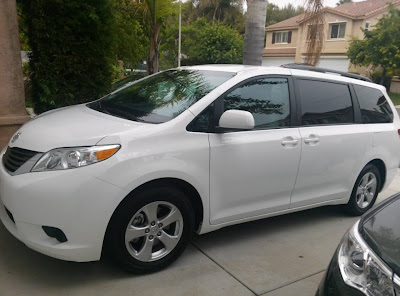
This necessitated my bringing my brand new van back to the service department and leaving it with them for the day and taking a rental car instead.
So, in the past week, I have taken two car seats out of the old car, installed them in the new car, then taken them out of the new car, installed them in the rental, taken them out of the rental, and re-installed them in the new car. All at 20 weeks pregnant, I might add.

And this brings me to my major point today. It is very important that you know how to remove and re-install your car seats properly.
While I often recommend that you have your seats installed and/or checked by a Certified Passenger Safety Technician (CPST) near you (often found as a free service through your local police or fire station or hospital), you also must know how to manage your car seats on your own. There will inevitably come a time when you need to move your car seat(s) from one car to another, or take them out to clean them or the car, or rearrange them.
1. Have your seats professionally installed at least once.
If you have the opportunity, absolutely have your car seats installed and/or checked by a CPST. This will reassure you that your seats are, in fact, being used correctly. If you make any changes, such as switching from an infant carrier to a convertible seat, or turning a rear-facing car seat to face front, or adding a second car seat, you may want to return to the CPST and have them reinstall or recheck your new configuration.
2. Ask the CPST to SHOW YOU HOW to install the seat yourself.
While the CPST is doing the installation, watch what they're doing. A good CPST will show you how to fasten and lock the seat belt or use the LATCH connectors, how much to tighten the belts, and how to tell if you have a good install. S/he should also be able to show you how to correctly buckle your child into the seat. If you can, take pictures of how the seat looks when it's correctly installed.
3. READ YOUR MANUAL.
While there are some generalities we can make about car seats, each one may have some slight differences in the details. You should be familiar with your manual, know where to find it (if you can't find the one that came in your box, most companies have them available online for download), and read the instructions when attempting to remove or install the seat by yourself.
4. Know these general rules.

This necessitated my bringing my brand new van back to the service department and leaving it with them for the day and taking a rental car instead.
So, in the past week, I have taken two car seats out of the old car, installed them in the new car, then taken them out of the new car, installed them in the rental, taken them out of the rental, and re-installed them in the new car. All at 20 weeks pregnant, I might add.

G likes the new van.
And this brings me to my major point today. It is very important that you know how to remove and re-install your car seats properly.
While I often recommend that you have your seats installed and/or checked by a Certified Passenger Safety Technician (CPST) near you (often found as a free service through your local police or fire station or hospital), you also must know how to manage your car seats on your own. There will inevitably come a time when you need to move your car seat(s) from one car to another, or take them out to clean them or the car, or rearrange them.
1. Have your seats professionally installed at least once.
If you have the opportunity, absolutely have your car seats installed and/or checked by a CPST. This will reassure you that your seats are, in fact, being used correctly. If you make any changes, such as switching from an infant carrier to a convertible seat, or turning a rear-facing car seat to face front, or adding a second car seat, you may want to return to the CPST and have them reinstall or recheck your new configuration.
2. Ask the CPST to SHOW YOU HOW to install the seat yourself.
While the CPST is doing the installation, watch what they're doing. A good CPST will show you how to fasten and lock the seat belt or use the LATCH connectors, how much to tighten the belts, and how to tell if you have a good install. S/he should also be able to show you how to correctly buckle your child into the seat. If you can, take pictures of how the seat looks when it's correctly installed.
3. READ YOUR MANUAL.
While there are some generalities we can make about car seats, each one may have some slight differences in the details. You should be familiar with your manual, know where to find it (if you can't find the one that came in your box, most companies have them available online for download), and read the instructions when attempting to remove or install the seat by yourself.
4. Know these general rules.
- Use LATCH or seat belt, but NOT BOTH to install the seat.
- Make sure you use the proper belt path for forward or rear-facing. This path should be marked on the side of the car seat itself.
- Make sure the LATCH or seat belt strap is not twisted as you feed it through the belt path.
- When forward-facing, you MUST use the top tether. If there is no hook for the top tether in the location you have chosen, then you cannot install the seat in that position.
- The LATCH or seat belt should be tight enough that you cannot jiggle the car seat more than ONE INCH side-to-side or forward and back.
- If using the seat belt, make sure that it is LOCKED. In newer cars, this simply means you should pull it all the way out and then let it retract. Tug on it to make sure it is locked.
- Look in both your car seat manual and your car's manual to check if the LATCH has an upper weight limit. If your child has reached this limit, you MUST install with the seat belt and stow the LATCH connectors.
Remember that the best car seat for your child is one that is installed and used correctly!
Monday, January 21, 2013
Car Seat Rule #4: When and How to Forward-Face
This is the fourth in my Car Seat Rules series, in which I focus on one aspect of car seat use in a small, digestible article.
See other Car Seat Rules articles here:
Rule #1, on the Chest Clip
Rule #2, on Rear-Facing
Rule #3, on Newborns
*The advice given in the Car Seat Rules articles is not a substitute for having your seats checked by a car seat professional (CPST) or for reading the manual that came with your car seat.
--------------------------
I spend a lot of time trying to convince you to keep your baby rear-facing as long as possible, but at some point, your child will outgrow the rear-facing specifications of his convertible car seat, or you'll reach a point where you just have to turn him around for some other reason. Many, many car seats on the market now allow children to remain rear-facing up to 40 or 45 pounds. Many children don't reach that weight until four or five years old! Your child has outgrown his rear-facing car seat when: Your child has reached the weight limit for rear-facing (outgrown by weight) OR the top of your child's head is within 1" (one inch) of the top of the car seat (outgrown by height). (Note that "feet touching the back of the vehicle seat" is not one of the criteria.)
When it's finally time to turn your car seat around, you'll need to know how to properly install the seat and secure your child in the forward-facing position. Once you've turned your child forward-facing, it is best to continue using a five-point harness until he outgrows the front-facing specifications for his convertible car seat. Many, many car seats on the market allow a child to remain in a five-point harness until 65 pounds. To get an idea of how big that is, my six-year-old isn't 65 pounds yet, and he's quite big for his age. Some go as high as 85 pounds.
Your child has outgrown the forward facing limits of his car seat when: Your child has reached the upper weight limit of his five-point harness (outgrown by weight) OR his shoulders are above the highest shoulder strap slot (outgrown by shoulder height) OR his ears are above the top of the car seat (outgrown by height).
Most of the same rules apply otherwise for front-facing that I've gone over for rear-facing. The main difference is that when adjusting the harness straps, you need to use a slot that is AT or ABOVE your child's shoulders (not below). If you use a slot below your child's shoulders, he will not be properly restrained and even may be able to wiggle out of the straps.
Buckling your child in a five-point harness, front-facing:
See other Car Seat Rules articles here:
Rule #1, on the Chest Clip
Rule #2, on Rear-Facing
Rule #3, on Newborns
*The advice given in the Car Seat Rules articles is not a substitute for having your seats checked by a car seat professional (CPST) or for reading the manual that came with your car seat.
--------------------------
I spend a lot of time trying to convince you to keep your baby rear-facing as long as possible, but at some point, your child will outgrow the rear-facing specifications of his convertible car seat, or you'll reach a point where you just have to turn him around for some other reason. Many, many car seats on the market now allow children to remain rear-facing up to 40 or 45 pounds. Many children don't reach that weight until four or five years old! Your child has outgrown his rear-facing car seat when: Your child has reached the weight limit for rear-facing (outgrown by weight) OR the top of your child's head is within 1" (one inch) of the top of the car seat (outgrown by height). (Note that "feet touching the back of the vehicle seat" is not one of the criteria.)
When it's finally time to turn your car seat around, you'll need to know how to properly install the seat and secure your child in the forward-facing position. Once you've turned your child forward-facing, it is best to continue using a five-point harness until he outgrows the front-facing specifications for his convertible car seat. Many, many car seats on the market allow a child to remain in a five-point harness until 65 pounds. To get an idea of how big that is, my six-year-old isn't 65 pounds yet, and he's quite big for his age. Some go as high as 85 pounds.
Your child has outgrown the forward facing limits of his car seat when: Your child has reached the upper weight limit of his five-point harness (outgrown by weight) OR his shoulders are above the highest shoulder strap slot (outgrown by shoulder height) OR his ears are above the top of the car seat (outgrown by height).
Most of the same rules apply otherwise for front-facing that I've gone over for rear-facing. The main difference is that when adjusting the harness straps, you need to use a slot that is AT or ABOVE your child's shoulders (not below). If you use a slot below your child's shoulders, he will not be properly restrained and even may be able to wiggle out of the straps.
Buckling your child in a five-point harness, front-facing:
- Place your child (or have him climb) into the seat. Make sure his bottom is all the way to the back of the seat and that he's sitting up straight.
- Pull the harness straps over his shoulders and pull the crotch strap up between his legs.
- Fasten the buckles.
- Fasten the chest clip.
- Tighten the harness. Tug on the shoulder straps to pull out any slack around the hips and then tighten the straps more if needed. Do the "pinch test" to make sure the straps are tight enough: Try to pinch the harness webbing between your thumb and forefinger at the child's collarbone. If you can't maintain a fold in the strap, it is tight enough.
- Align the chest clip with the child's nipples or armpits.
Check out this video of my middle son being buckled into his five-point harness.
Installing your convertible car seat front-facing:
- Before placing the seat in the car, check your manual for whether the car seat can be reclined while forward facing. Put the car seat in an upright or allowable recline position before installing.
- Have your child sit in the car seat before installing it in your car. Identify the shoulder strap slot that is closest to, but still above your child's shoulders. Re-thread (if necessary) the harness straps. (See your manual for instructions.) Remember that as your child grows, you will need to periodically readjust the harness height. (Some car seats have harnesses that are adjustable "on the fly," meaning you don't have to take the seat out of your car to adjust them. If you have one like this, you can skip this step.)
- Locate the belt path that should be used for a front-facing installation. It should be clearly marked on the seat itself. (Usually, there are arrows pointing to the slots with the words "forward-facing belt path" or similar language.) If you're installing using LATCH, feed the latch straps through this path. Make sure they're not twisted. If you're installing with the seat belt of the car, stow the LATCH straps appropriately. (Note that you can install a car seat equally safely using either LATCH or the vehicle seat belt, but NOT BOTH together.)
- Place the seat in the car so that the child will be facing the FRONT of the car.
- Locate and extend the top tether strap from the back of the seat. Loosen it as much as necessary until you can hook it into the top tether connector on your vehicle seat. This may be located just behind the head rest of the vehicle seat, somewhere on the back of the seat in an SUV or minivan, or sometimes in the ceiling of the car. There should be a tether hook for each rear seat in the vehicle where it is permissible to install a car seat; use the hook associated with the vehicle seat you are using. If there is no top tether hook for the seat you were planning to use, you must install the car seat in a different location. (Note that your front-facing car seat is not properly installed if you do not connect the top tether!)
- If using LATCH, snap the LATCH connectors into the LATCH hooks in your vehicle. OR If using the vehicle seat belt, feed the belt through the front-facing belt path. Make sure the belt is not twisted. Buckle the seat belt. Then, loosen the seat belt ALL THE WAY until it locks and then allow it to retract. On an older vehicle, the seat belt may not automatically lock when pulled out all the way. In this case, you'll need to use a seat belt locking clip.
- Climb into the seat and lean in with your knee to squish down the vehicle seat. Tighten the LATCH straps as much as you can by hand. (Do not use any aftermarket mechanical tighteners.) OR tug on the seat belt so it will retract as far as possible. Tighten the top tether strap as much as you can.
- Standing on the floor of the car or outside the car, grasp the car seat with your stronger hand right at the belt path and attempt to wiggle it. If it shifts more than 1" (one inch) side to side or front to back, the LATCH or seat belt is not tight enough. Lean into the seat again and try to tighten it further.
Other tips:
- Older children may want to buckle themselves. If they're physically capable, I encourage you to allow them to do so, but always check to make sure the harness is tight enough and that the chest clip is properly positioned.
- Some children play with the chest clip, try to wiggle out of the straps, etc. This is a discipline issue, and it needs to be handled in the same way you would handle other undesirable behaviors. You can try positive reinforcement (every time you complete a car ride without them messing with the clip or the harness, they get a prize or something), consequences (if you have to stop to fix the straps, they lose a privilege), or some combination. I have also found it very helpful to talk to my kids about the importance of being in the car seat, how it helps keep them safe, and they take pride in knowing how to be properly buckled in. They will even fix their own chest clip if they are buckled incorrectly.
- Do not dress your child in heavy winter clothing or extra layers when they are in their car seats. Puffy coats will interfere with properly positioning and tightening the harness. It is recommended to remove bulky clothing just prior to buckling the seat, then put the coat or blanket over the child after he is harnessed.
- Some kids will not be happy about still being in a car seat when some of their friends have "graduated" to a booster. As above, you can talk about the importance of being safe in the car. I'd say that this falls under the "if all your friends jumped off a cliff..." category of parenting. Just because their friends' parents let them sit in a booster doesn't mean you have to allow your child to be less safe in the car.
- Nothing should go between the car seat and the vehicle seat. Unless your car seat manual specifically states that you may place a towel, blanket, or car seat mat under your car seat, then you should not do so. Anything between the car seat and the vehicle seat may prevent you from properly tightening the LATCH straps or seat belt. If you're not sure, you can contact the manufacturer and ask.
- If it didn't come in the box with the car seat, you shouldn't use it with the car seat. This includes shoulder strap padding (most car seats come with these anyway, but if yours didn't, don't buy them from somewhere else), head or neck support pillows, toys, etc. Nothing should go between the child and the car seat except the clothing the child is wearing, and nothing should be attached to or interfere with the harness straps.
Your child is ready for a booster seat when...
- He has reached the minimum weight AND height limits by state law (minimum is usually 4 years AND 40 pounds) AND
- The seat belt fits him properly across his shoulder (not neck), breastbone, and upper thighs (not stomach) AND
- He can remain seated upright through the whole car trip and does not lean or slouch (if he is not seated properly, the seat belt will not restrain him properly) AND
- You trust that he will not unbuckle his seat belt in the middle of a car ride.
Please remember that an ill-fitting seat belt can do more harm than good. If your child is too small to be using a seat belt (even with a booster seat), in a crash the seat belt can cause internal injuries that would be avoided by using a five-point harness instead.
Saturday, November 17, 2012
Watch My 4-Year-Old Get Into His Car Seat
Jessica on Babies now has a YouTube channel. I intend to post informational videos about Jessica on Babies topics. The inaugural video is SB getting buckled into his car seat. SB rides in a Sunshine Kids (now Diono) Radian65, front-facing. He will be four next month. The Radian65 has a front-facing weight limit of 65 pounds. SB is about 34 pounds and 38" tall. That means he has lots of room to grow in his car seat.
I took this video with my phone. I would like to purchase a proper digital video camera and some video editing software in order to make higher-quality videos for the YouTube channel. For ways to help me raise the funds for such a purchase, check out the "Support Us" page or see the "Support Jessica on Babies" section on the right side of this page.
Please subscribe to the YouTube channel to see new videos as they're posted. Thanks for watching!
I took this video with my phone. I would like to purchase a proper digital video camera and some video editing software in order to make higher-quality videos for the YouTube channel. For ways to help me raise the funds for such a purchase, check out the "Support Us" page or see the "Support Jessica on Babies" section on the right side of this page.
Please subscribe to the YouTube channel to see new videos as they're posted. Thanks for watching!
Subscribe to:
Posts (Atom)