Wednesday, February 26, 2014

What Do You Do with Baby Clothes When You No Longer Need Them?

As my youngest, who just turned four months, begins to outgrow his clothing, I'm finding in myself an unexpected sentimentality. Many of the baby clothes we have were originally my oldest's (now seven years old!) and have been handed down to each of the boys in turn. There are several outfits that all four have worn, and every time I bring out a box of the next size up, I am heard to squeal, "Oh, this was my favorite! No, this was my favorite!" I look forward to putting certain outfits on the new baby as he grows into them.

I do buy the occasional new bodysuit or sleeper, or sometimes I see a little outfit I love and can't resist purchasing, but this handing-down from one kid to the next means I don't ever have to buy anyone a whole new wardrobe...except the oldest. In fact, I'm so used to being able to just go into the garage and pull out the box of next-size-up clothing that I'm actually resentful at having to buy new clothes for my oldest as he outgrows or wears out his clothes.

Since we've basically decided that four kids is our limit, I no longer need to keep clothes to hand down once the youngest goes up a size. My baby is quickly growing into the 6-9 month size clothing, and I have retired the newborn and 0-3 month stuff. As I put the box away, I realized, I don't need to keep any of these. I have no one to save them for. I can throw them away, or give them away, but I don't need them in my house anymore.

It's a bittersweet feeling. On the one hand, it'll be nice to finally free up some storage space by getting rid of these giant tubs of clothes. On the other hand, it's an odd thought that, after seven years, I don't have to save things.

And I'm finding that I want to preserve the memories attached to some of the outfits. I pulled this yellow duck outfit from Baby Y's drawer and realized it's the outfit my oldest came home from the hospital in.

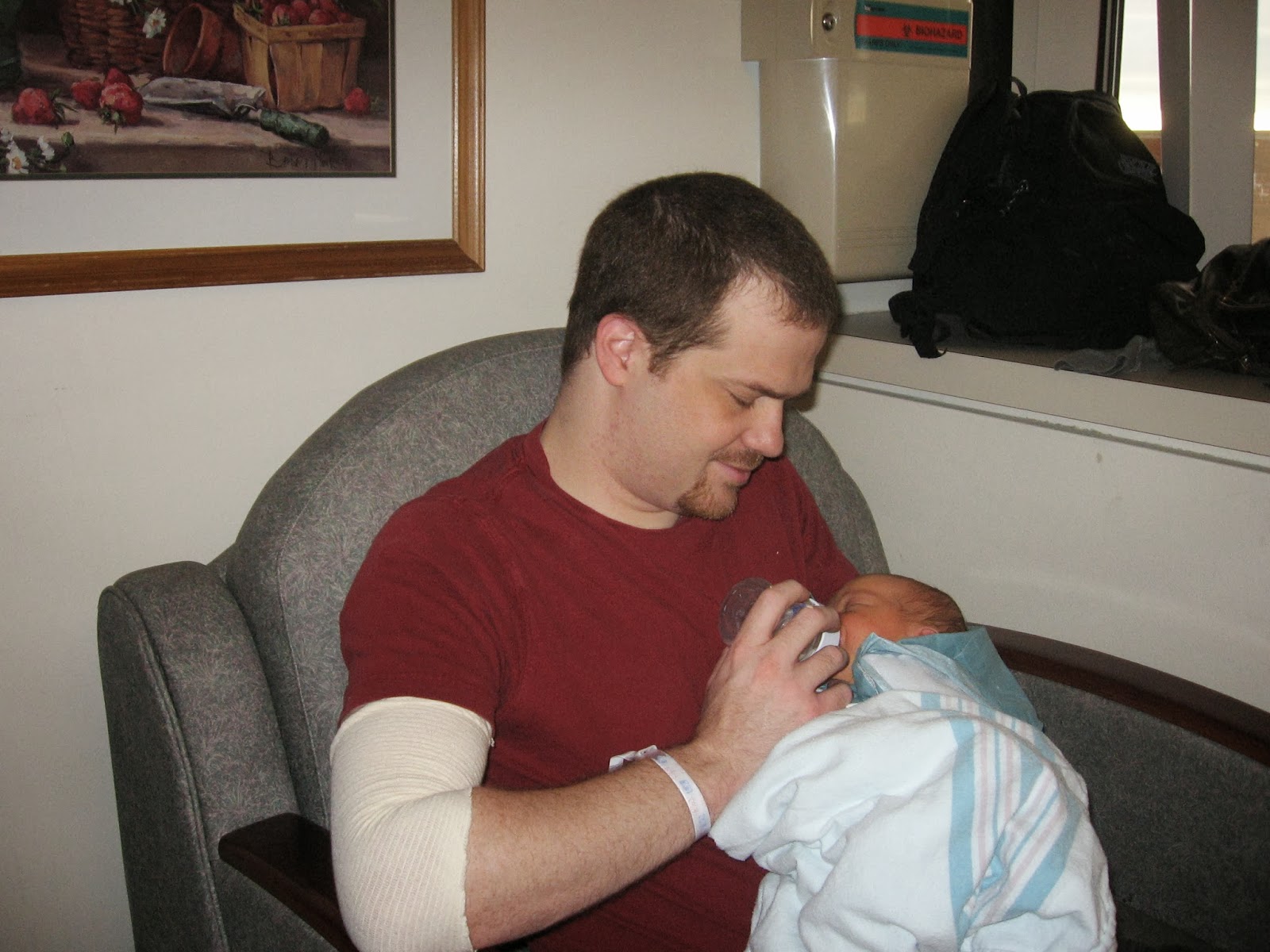
Baby N, four days old

Baby G, six weeks old

It was too big for the 9-pound Baby N when he first wore it, over seven years ago. We had forgotten to bring a "going-home" outfit with us to the hospital, and someone had brought us this outfit as a gift, so we dressed him it in for the occasion.

But when I put it on the 18-pound, four-month-old Baby Y, it was a smidge too small. The top snap is missing - torn off in some washing in a previous lifetime. I put it in the "too small" tub and brought in the next size up, 6-9 month. I rummaged around to find a "new" outfit, which fits Baby Y perfectly. This, too, was originally N's. I remember S wearing it. I'm not certain if G wore it.

Baby N, three months old

Baby Y, four months old

But this tub, again, is full of seven-year-old outfits, well loved and well worn, but still usable and adorable.

Baby N, five months old.
Baby S, four months old

I just spent quite a while combing through old pictures, hoping to find that I had a picture of each kid in the same outfit, but so far I've come up empty. I have N and S in the same outfit, or even N and G in the same outfit, or S and G in the same outfit, but not all three or, better yet, all four.
Baby S, six months old (with Grandma)

Baby G, five months old

I've read of people craftier than I who have made quilts out of old baby clothes or found other ways to create lasting or useful mementos from them, but I am not that crafty or creative. Still, I like the idea of keeping some of the outfits, somehow, in some form. I don't want to keep tubs and tubs worth of clothes I don't need, of course, but I think I'd like to save a couple of outfits. Part of me likes the idea of giving an outfit to one of my sons, fully grown and a father himself, and saying, "You and your brothers wore this as a baby."

It's as if the clothes in some way carry the memories of the babies who wore them. Most of the clothes, I remember who gave them to us, or when I bought them, or where they came from. I remember a specific instance or photo when one of the babies was wearing a particular sleeper or overalls. Clothes that weren't bought for my kids but were handed down or over from friends whose babies outgrew them somehow feel less "mine." They have other babies' memories attached instead, other parents' styles.

Some outfits have been thrown away over the years because they were irrevocably stained, or torn, or lost too many snaps or buttons. Some can't be passed along anymore because they're almost unusable or simply worn out. But a few of them have held on, going from baby to baby and staying in relatively good condition. In a way, I'd hate to cut those up to make a quilt or something anyway, since they're still wearable. I'm still thinking about what I'd like to do.

Have you saved your babies clothes as they're outgrown, or do you prefer to pass things along as soon as you don't need them? What creative ways have you seen to preserve the memories attached to baby clothes?

Thursday, February 20, 2014

Why I Vaccinate My Children

My youngest, Baby Y, had his four-month well-baby checkup today. He weighed in at a healthy 18 pounds even and was a robust 26.75 inches long. At four months, he is rivaling his three brothers for size and chunkiness. Four months also meant a second round of vaccinations for my little one. He needed rotavirus, which is administered orally, as well as shots for hepatitis B, Hib, pneumococcal, diphtheria, pertussis, tetanus, and polio (some were combined, so it was three shots total). He didn't even react when the first shot was given, and cried briefly after the third. He slept for a few hours and is now playing happily, like nothing happened.


Of course, something did happen. Something extraordinary, really, if you think about it. A hundred years ago, diseases like polio ravaged young children, killing or paralyzing many. Diphtheria was a real threat, as was pertussis (whooping cough). While whooping cough isn't terribly dangerous today to those with developed immune systems, it can be, and often is, fatal for young babies. Vaccinations are one of the greatest medical advances of our time, along with antibiotics, improving length and quality of life and preventing much childhood suffering.

My husband and I choose to vaccinate our children according to the CDC schedule. We believe that it is not only our responsibility to our own children but to society at large to aid in limiting the spread of preventable diseases. My children are growing up in a world where they don't have to worry about losing a sibling to polio or a friend to pneumococcal disease or meningitis, and they are growing up in such a world because of the miracle of vaccinations. We can and will do our part to protect our own children and those they come in contact with.

We are not sheep blindly following our doctors' recommendations and the "guv'mint's" instructions. We are aware of the arguments against vaccinations and for delaying them. We are also aware of the science behind vaccinations, how they work, and that there are risks that come with giving vaccinations. We believe that the benefits of vaccination far outweigh the risks and that the risks posed by the diseases prevented by vaccines far outweigh the risks posed by the vaccines themselves.

Because my children have shown no adverse reaction to being vaccinated, I am very comfortable continuing to have them receive immunizations on schedule at their regular physicals. The only shot I refuse is the hepatitis B shot at birth. Its purpose is to prevent vertical transmission of hep B from mother to baby, and since I do not have hepatitis B (and, indeed, was vaccinated for it and received a booster series as a teenager), I feel it is unnecessary to add anything to a newborn's already busy first few weeks of life. The hep B schedule, then, starts at two months for my kids instead of birth. I also will put off a vaccination for a few weeks if my child is sick, because I want to be sure of the source of any symptoms. This is all per the recommendations of my doctor and the CDC.

Some children do have adverse reactions to vaccines, and in some cases these reactions are life-changing or even fatal. I know that. Any time we add something that nature didn't put there, we assume risk. Any medical procedure we undertake, any medication we take, any surgery we opt for puts us at risk that doesn't exist without that action. But we also assume risk when we do not avail ourselves of the advantages afforded us by modern medicine. Many of these diseases we vaccinate against carry a risk of suffering and even death. These are not trivial diseases. Polio is not like a minor cold. Pertussis is not a little cough. It is unacceptable, to me, to expose my children to these greater risks of disease, suffering, and possibly life-altering complications when the alternative is a little shot a few times as a baby, and possibly a booster when they're older, even given the possible risks and side effects of the vaccines themselves.

Vaccines generally work for the individual, but they work better when everyone gets them. If there is a measles outbreak in my town, for example, brought in by someone not vaccinated against measles, it puts my children at risk because the vaccine may not be 100% effective for them. However, their chances of being exposed to measles are considerably lower because the majority of people they come in contact with are also vaccinated. If one of my children were to be exposed to measles, it puts my young baby at risk because he is not old enough yet to receive the vaccine and could be infected with measles. The more people who are vaccinated against measles, the smaller the chance that anyone in my family will be exposed to it. And, vice versa, if my family members are vaccinated against measles, it reduces the chances that the people they come in contact with could be exposed to measles through them.

We protect each other by protecting ourselves.


Finally, there are definitely some individuals who cannot be vaccinated. Perhaps their immune systems are compromised. Perhaps they are allergic to an ingredient in the vaccine. Perhaps they have had a severe reaction in the past to an injection and cannot risk repeating that scenario. The rest of us being vaccinated also protects those individuals who cannot be vaccinated.

We've all seen how easily a cold or cough or stomach virus races through an office or classroom. Imagine if instead of fighting off cold-weather stuffy noses and the occasional 24-hour stomach bug, we were also constantly in fear of catching diphtheria or whooping cough.

Scary to contemplate, isn't it?

Protect your children. Protect my children. Protect the children who can't protect themselves. I vaccinate. Will you?

Friday, February 14, 2014

Why I Didn't Breastfeed My First Baby

My oldest son is 7. He was mostly formula-fed from birth, and completely formula-fed from about 7 weeks of age.

Given the person I am now, the breastfeeding advocate and educator, who has successfully breastfed three subsequent children, sometimes I look back and can't quite believe he wasn't breastfed. But his birth and my experience with him is what made me so passionate about birth and breastfeeding in the first place.

But why wasn't he breastfed?


Was it awareness, or lack thereof?
I don't think so. I was aware of the benefits of breastfeeding. I intended to breastfeed him. In fact, here's an excerpt from a LiveJournal entry I wrote when I was about eight months pregnant: 
The doctor asked if we'd taken any classes, which we have. She said, "Oh good, so you're prepared." Haha! Yes! I feel so prepared! Ok, I know the basics, and sort of what to expect. But prepared? I don't think you can ever really be prepared for your first childbirth. I mean, ok, the nursery is almost ready, he'll have clothes to wear and a place to sleep and something to eat (boobies!), but seriously. Prepared? I keep trying to remember the signs of labor and thinking how this class we took has a doozy of a final exam!
Then, about a week before the baby was born:
I went ahead and ordered a dual electric breast pump...Still cheaper than formula in the long run, and I hope that I will be able to give him breastmilk for as long as possible. 
So I was definitely "aware" of breastfeeding, of the benefits, that I wanted to breastfeed. I had made that decision and was planning ahead.

Was it education, or lack thereof?
This was part of it. And I think one of the big problems was, I didn't know I needed to be educated. I bought a couple of breastfeeding books, but I didn't read them. I didn't take a class, didn't attend any LLL meetings, didn't talk to other breastfeeding mothers about their experiences. Indeed, as the birth story I wrote just a couple of weeks after he was born shows, I didn't know what I didn't know:
They brought the baby to me and helped me latch him. He knew what to do, but I was still pretty out of it. I also have the timeline here a bit befuddled, because of what ensued. I know they needed to check his blood sugars because of his size, and asked us if it would be ok to give him some formula if he needed it, and if so, what kind. We said it was ok, but we didn't know anything about formulas, so just go ahead and give him whatever they thought was good. They suggested Enfamil with Lipil. Sure, why not.


If I had done any reading or taken a class, I would probably have known that he likely didn't need to be given formula, or we would have at least known to ask more questions. As it turned out, his blood sugars were fine, but I soon went into shock due to blood loss from the delivery. The nurses told me that because I'd lost so much blood, I wouldn't be able to make milk:
I didn't get a chance to try nursing again. I needed to rebuild my blood supply before I could even think about making milk.
I was stuck in bed for all of Sunday and Monday. They came and checked my bleeding periodically, gave me IV pain meds, brought me food. They brought the baby in on Monday for me to try nursing again, but I was pretty weak and sore. They were giving him formula, which was fine. With his size, he needed to eat, and I didn't have food for him. 
What no one told me, apparently, was that in order to make milk, I needed to nurse the baby. Even if my milk supply increase was delayed, I still needed to be nursing him and/or pumping to set up prolactin receptors and to encourage milk production. Even if he had to be supplemented with formula, that didn't mean I shouldn't nurse him. The colostrum would benefit him, too. I do recall that they fed him whatever colostrum I pumped, but it wasn't much.

Was it willpower?
Yes. I'm sure a big part of the problem was willpower. Now, I went through a traumatic birth, and I got off to a bit of a rocky start, but that alone didn't make breastfeeding impossible. The bigger problem in this story is that I didn't know how much hard work it takes in the beginning, especially when there's a rocky start, to breastfeed. I didn't know that if I stuck with it, it would get better and easier and really feel worthwhile, and so I didn't try.

Was it support, or lack thereof?
Yes and no. The support in the hospital was variable, as evidenced by some of the quotes above. Then there was this:
[On Tuesday, the lactation consultant] showed me how to use the pump and said I'd need to pump for 15-20 minutes every 2-3 hours to stimulate milk flow and establish a supply. She also suggested I rent a hospital-grade pump, because the one I'd bought would burn out if I used it that often. I think I pumped twice that day. With all the people in and out and all the activity, and my general weakness, pumping seemed like just that much more hassle, that much more of an energy drain.

Wednesday was better, and I did pretty well with pumping. A different lactation consultant came to see me and helped me breastfeed the baby. I tried the football hold, because of my sore abdomen, and the cross-cradle, which I found more comfortable. They told me I should breastfeed for 10 minutes per side and then pump for 10 more minutes.
This information is only sort of correct, and she didn't say the most basic thing, which is, "You have to nurse the baby to make milk, and here's why." She didn't say, "The best thing you can do to bring in your milk is to nurse the baby." She didn't say, "Spend time skin-to-skin with your baby and nurse on demand." She didn't say, "Watch the baby, not the clock." Etc. And no one, again, told me that it was hard work and perseverance that would matter the most. Everyone said it was fine to supplement with formula, and no one, not even me, fought for me to breastfeed.


On the other hand, my mom wanted me to breastfeed. She wanted me to so badly. But she didn't know how to support me, and I didn't know I needed support or how that support should look. A friend tried to help; she even offered to nurse the baby for me to show me how it works! She offered me the contact information for a local La Leche League leader. She knew I needed support, and she knew how to give it, but I didn't know how to take it, or that I should, and I was convinced that I should do what I was told by the hospital, not knowing, as many women don't, that the nurses at the hospital maybe weren't the be-all and end-all of breastfeeding information.

How did I feel about "failing" to breastfeed?
Well, there's this, from about 3 weeks postpartum:
I know these are questions best put to a lactation consultant, but I really want a more unbiased analysis. I want a totally practically-minded opinion, and I feel like an LC would push me to try breastfeeding, when I find it so discouraging. It's the lactation consultants who first told me to pump 8 times a day, and I didn't manage to do that and it just made me feel bad. I know that's what I'd need to do to boost my supply, but it's really hard. I don't know whom to turn to or whom to ask, and it's very upsetting. Breastfeeding is the one thing only I can do for my son, and I'm not even sure I want to do it. I know I'm not alone. I know there are other mothers out there who tried to breastfeed and just didn't want to. But I never thought I'd be one of them. I never thought I'd find it so difficult or, frankly, unpleasant.

I mean, anyone can mix some formula in a bottle and put it in his mouth. Many people have over the last 3 weeks, although it's his father who does it most often. But only I can produce breastmilk for him.
"I don't know whom to turn to or whom to ask...Breastfeeding is the one thing only I can do for my son..." I was so torn, and confused, and I didn't have the information I needed. I didn't want someone who would "push" me to breastfeed, and I thought all lactation consultants would be like the ones I saw in the hospital, who I didn't find to be helpful and I did find to be pushy. But that was exactly what I needed, someone who would "push" me to breastfeed. I didn't realize, you either breastfeed or you don't, and I certainly could have. (In that same post, I lamented that I "only" pumped 2 to 3 ounces in a sitting, having no idea that's actually quite good!)

And there's this, from one month postpartum:
I've been crying a lot. I think one reason is that I feel bad about having to give up on breastfeeding. I know I had so many extenuating circumstances that it would have taken a rather heroic effort to really get in there and exclusively breastfeed, but knowing the reasons doesn't make me less frustrated that things aren't working out the way I'd hoped they would.
And this:
A couple of women I know have recommended an LC in the neighborhood. Maybe I should talk to her. I don't know. I just want to feel better. I want to feel like I've resolved this for myself, and right now I obviously don't. If I try and fail, will I feel worse, or will I at least be able to say I tried? If I try and succeed, will I find the joy in it that I am hoping to find, or will I just get discouraged again? 
And then at six weeks, I thought I might try to relactate:
[I tried putting him to breast...] And even more exciting, milk came out! I thought my milk was dried up, but he got some out. Not very much, but enough that he was willing to keep sucking. So I let him. (Ow) 10 minutes on each side, he sucked. And milk came out on both sides. I let him keep going until it got too painful and he got too squirmy. I think he got a little frustrated when he wasn't the least bit satisfied after 20 minutes of sucking. I would be too, hehe.

Then we gave him a bottle of formula and he gobbled down 6 ounces, so I know he hardly got anything from me. But I wasn't so much interested in volume as ability. That was pretty exciting. My nipples are still sore this morning from it, but it felt really good emotionally.


I was not successful, but it's clear that I wanted to try, and I gave it a go. I even finally contacted the La Leche League leader that I should have spoken to in that first week! If my birth had gone more smoothly, I probably would have breastfed. I can't change the craziness that was my oldest son's first six weeks of life, but I think the lessons of what I went through can give us all some perspective on what other women might actually need, and how we can provide that.

What can we learn from my experiences?
I think we need to give most women, especially middle class, educated women, enough credit to assume they know about breastfeeding. It's not a lack of awareness that causes women not to meet their breastfeeding goals. After all, something like 90% of women state an intention to breastfeed upon giving birth, yet less than a third of them are still breastfeeding at six months postpartum, and not even half are still exclusively breastfeeding at six weeks. Something goes wrong in those first few days postpartum and in the early weeks.

I think the biggest factor in improving breastfeeding rates and success is education, followed closely by support. Education and support work hand-in-hand. First, we educate women not about why they should breastfeed (or not just about why), but about how breastfeeding works and what they can expect. Second, we educate women about finding and/or building a support network, to have phone numbers on hand they can call, websites to visit, books to read, to let them know that they can and should ask for help, that they don't have to - and shouldn't have to - go it alone, and that there's no shame in having a little trouble at the beginning. Third, we provide that support network, with continuity prenatally, at birth, and in the weeks following the birth. Whether they join a La Leche League meeting, are friends with an experienced breastfeeding mother, or get all their help online from blogs and Facebook, women and their partners need to know (a) they probably will need help; (b) it's okay to ask for help; and (c) where that help can be found.

It's amazing that I documented my experiences with such detail in the moment. It's hard to look back seven years through the lens of who I've become and remember what I was feeling at the time. Because I wrote it all down at the time, it's all out there, raw and visceral, and I can see right there what I knew, what I had, and what was missing. Filling in those missing pieces for other women can make a huge difference in their lives and the lives of their children.

***

To read the full account of my oldest's birth, see the four-part story starting here

For a quick-start guide to breastfeeding that answers many of the most common questions new mothers have, check out my e-book, The Jessica on Babies Breastfeeding FAQ, available for Kindle from Amazon.

Monday, February 10, 2014

Should We "Dread" Our Children's Growing Up?

The other day, I wrote a post delving into my feelings about having only boys. It was very popular and got a very positive response, but talking about it with some friends got me thinking a bit more.

In that previous post, I wrote that I sometimes joke about my relief that I won't have to experience the girl tween years, or puberty, or uniquely feminine drama. A few days later, I met up with a friend who has a toddler daughter, and we talked about how she is dreading those years. We laughed about how with boys, they get angry, they punch each other, and it's done with, whereas girls let things simmer and hold grudges. The day after having this conversation, I met a woman who said her grandmother had four boys but really wanted a daughter, tried one more time, and the fifth was a girl. I have encounters like that a lot. Somehow, when I had just two boys, it wasn't cause for comment, since having two kids is pretty average, and you just got lucky to have two of the same gender. If you have three, you start getting the question, "Were you trying for a girl?" as if somehow your family isn't complete unless you have at least one of each. But once you hit four, people are certain that you've "kept going" because you're "trying for the girl" and that you will keep going because you desire that daughter so strongly. Is it the same for parents with four girls? Do they get strangers asking if they're "trying for the boy?" I don't know. I imagine so. (Any parents of three-plus girls want to weigh in?) I usually just say that my husband and I wanted four kids, and this was just the luck of the draw in terms of sex. We weren't "trying" for anything, except "trying" to have four kids.

I keep going back in my mind to the idea of "dreading" a certain stage, though. I looked up the word "dread." It means: "anticipate with great apprehension or fear." And I don't like that wording. We should "dread" getting a diagnosis of a terrible disease (G-d forbid!). We should "dread" a terrible earthquake (or another winter like those of you on the East Coast of the US are having) - G-d forbid! We "dread" inevitable sadnesses or tragedies, like the death of close loved ones.

But "dreading" our children growing up and entering new phases? That doesn't seem right. Our children growing and maturing and attaining new facets of their personalities, new skills, new expectations, a new outlook on life - these are not things to be afraid of. These are causes for joy! This means we're doing something right! Our children are alive, thriving, opening up to new experiences and ideas.

Sure, there are phases that are more stressful than others. I imagine nine-year-old girls give their parents plenty of stressful moments. There are questions we're concerned we won't be able to answer, problems we hope they won't have to face (but probably will), traumas and difficult times we don't want them to have to go through (but they probably will). And we can anticipate how we'll address their worries when they come up, how we'll respond to their misbehavior, how we'll guide and direct them as they grow. But to "dread" the inevitable growing-up of our beloved children? I'm not sure that's the right word to use.

Some parents "dread" the day their child asks where babies come from, or they "dread" the day their elementary schooler asks about the events of 9/11/01, or Columbine, or Sandy Hook. Some parents "dread" having to explain why people have skin of a different color, or why someone at school made fun of them for their weight or religion or hair cut or interests, or why Chris has two Mommies, or where Grandma is, or what happened to the dog. And we do worry about these things, but is it intense fear? Is it great apprehension? I hope not!

What I'm finding as my kids get older and start asking questions like those is that, even if I "dreaded" getting the question or having the topic come up, once it did, it wasn't as bad as I expected. I know my kids pretty well, and I have a pretty good idea of what will upset them and what won't, what will interest them and what won't, what they'll understand and what they won't. I enjoy explaining things to them. I enjoy anticipating the next question they'll ask or the next idea they'll present. And so when something does come up, I find I do have the tools to handle it.

So if I had a girl, would I "dread" her getting her period, or having to explain about safe sex, or issues about her appearance, or things like that? No. Sure, I'd worry about them. I'd play out scripts and scenarios in my head in anticipation. Her behavior probably would stress me out, and I'd jokingly complain about having a girl and having these problems with her. But I also think I would be grateful to have a daughter. Just as I'm grateful now for having my sons.

And there are more serious things that might happen to our children, or that our children might do, as they grow up. And I think it's fair to dread some of those things. But the normal course of maturing is not something to dread. Having a tween girl or boy in itself is not a cause for terror. Knowing your sweet toddler daughter will one day be a hormonal mess isn't cause for "great apprehension or fear." I think, quite the opposite, that we should dread our children not becoming hormonal pimple machines! We would dread the idea of our children not experiencing the fullness of life, taking risks, and simply growing up. There are plenty of parents out there dreading the day they don't have their daughters giving them sass or their sons watching porn in their rooms.

Now, I realize that when we talk this way, we're exaggerating, using sarcasm as a defense mechanism. I know that saying we dread various stages isn't a literal paralyzing fear. It doesn't mean we aren't grateful for our children or that we don't love them. It doesn't mean we regret having them. But I think it's important to have perspective, too. Often the things we're most concerned about, once they come up, aren't as horrible as we anticipated. And knowing that we can anticipate those moments can help us manage those fears in advance, so we don't have to dread them.

So, yes, I joke that I'm glad not to have to deal with "girl" stuff, and I know I won't have the stress of my daughter coming home and asking for birth control, or having a fight with her best friend, or being made fun of because she doesn't have an American Girl doll, but I also won't have the joy that a daughter brings.

Maybe it's time to focus on the positive.

What are your favorite things about having a son? What are your favorite things about having a daughter? Did you have a preference before your baby was born? What are you most looking forward to sharing with your kids as they grow up?

Wednesday, February 5, 2014

Why Won't My Baby Nurse?

As your baby gets older (over three months old), some aspects of breastfeeding get easier: Your baby learns to latch properly and can do most of the work herself. You get more practiced at arranging yourself and your baby to nurse comfortably. Your nipple pain subsides and any damage heals. Your milk supply balances out so you're not constantly engorged or spraying your baby in the face. Your baby becomes more efficient at extracting milk and can finish a feeding much more quickly. She may be taking in more at a feeding and can go longer between nursing sessions. You've figured out what positions are comfortable for you and your baby. Your confidence improves, and with it your ability to relax while nursing.

And then, suddenly, you're hit with a new set of frustrations!

As babies reach three and four months of age, they start to "wake up" to the world. Their lives are no longer just about sleeping, eating, and pooping. Now they're smiling at faces, staring at interesting patterns and objects, trying to reach out and grab things. They want to sit up and roll over. Life is fascinating, and nursing, while still comforting and necessary, sometimes becomes an interruption to their exploration, rather than their priority. They've also decided what's comfortable for them, which may not always be your first choice.

At this point, you may find that your once-eager nurser has to be convinced to eat, won't eat in certain positions or places, or flat out screams at you when you offer the breast. This can be discouraging and make you feel like you're suddenly doing something wrong, just when you finally had it all figured out.

Take my baby, for instance. On our recent road trip, he decided he didn't want to nurse in the cradle hold sitting down. Oh, no. I had to stand and bounce, or lean over his car seat, or wait until we could curl up in bed at the hotel. The other day, we spent several hours at the Social Security office and he got hungry, but would he nurse happily? Of course not! I had to convince him he was hungry and tired, and he finally fell asleep after being walked and rocked for a while.


I find he nurses best when we're both relaxed and in a calm zone. At home, I usually take him to my bed and lie down with him to nurse. When we're out and about, I try to sit as comfortably as I can so that I can relax. The more rushed or tense I feel about having to nurse him, the less likely he is to simply latch and feed. Often, he will calm down without nursing. When he does, I usually just try to get him to wait until we're in a more convenient place for him to nurse. If he's really not willing to wait, I'll do anything and everything to get him latched and eating, no matter where we are.

I figure that if he gets three or four really good feedings in throughout the day, the snacking or fussy popping-on-and-off that he does the rest of the time is fine. He's still getting enough to eat, even if it's frustrating.

I think the number one rule is to relax. This applies to a lot of things when it comes to breastfeeding. Relax, follow the baby's lead, and don't stress about it. You can't force a baby to nurse, but you can remind him that he's hungry. If he really just doesn't want to latch right now, see if you can find another way to calm him. Sometimes once he's calm, he'll be more content to feed.

Some tricks that work for me when my baby is reluctant, for whatever reason, to nurse:
  • Try a different position. If I'm sitting down and using a cradle hold and he's resisting, I'll try standing up and using cross cradle to get him latched. Sometimes I even need to rock or bounce him while he nurses. Alternatively, if I have him in the carrier upright, I'll try taking him out (if possible!).
  • Try the other side. Sometimes my baby just doesn't like one side for some reason but will happily latch and nurse on the other side. 
  • Have him suck on something else, first. I'll give him a pacifier or a finger to suck for a few minutes. Sometimes this calms him down and reminds him that he's upset because he's hungry. Then he'll take the breast and eat well.
  • Let him pop on and off enough times to get letdown. When I'm nursing in public, I don't love it when he's popping on and off because I feel like I'm flashing everyone, but often once he gets letdown, he'll eat happily. If I'm in a place, position, or situation where I can let him do this, I'll go with it.
  • Try to calm him and wait until we're somewhere else. Sometimes he just doesn't like the location. I'll rock or bounce him for a bit, or roll him back and forth in the stroller, or drive around for a few minutes. This will calm him enough that he'll fall asleep, or he'll be willing to try again in a new place. For some reason, he seems to like when I dangle my boob into his mouth while he's in the car seat (when the car is PARKED, of course), so if that's an option, I'll do it, when all else fails.


While you shouldn't generally try to delay feeds when your baby is a newborn, once breastfeeding is going well, your baby is growing, and your milk supply is healthy, delaying a feed by 20 or 30 minutes isn't really going to harm anybody. You may be uncomfortable, and your baby may be unhappy, but it's not going to cause any long-term damage, especially if it means that he gets in a good feeding once you have the opportunity. I don't advocate skipping or delaying much more than 30 to 45 minutes, but it's not always up to you! When the baby just won't eat, he just won't eat!

Some other reasons your baby may be refusing to nurse at certain times or in certain places or positions:
  • Teething. Yes, babies can start to teeth as early as 3 months, even if teeth don't show up for a couple of months. Sometimes the pressure of sucking can increase teething pain (while other times it offers relief!). Teething pain comes in spurts of a couple of hours, which is why he may refuse at some times and not others. Teething pain may also be felt in the ears, and laying on one side may be more painful than the other side. This is why switching sides may be helpful.
  • Ear infection. As with teething pain, the pressure of an ear infection is worse when lying down. If you can nurse with him more upright, that may help. Also, lying on the side that is affected will be more painful than lying on the other side, so, again, nursing on the less painful side may be more effective.
  • Stuffy nose. A stuffy nose can make nursing difficult-to-impossible. She can't breathe and eat at the same time if her nose is stuffy. Squirting saline or breastmilk up the nose to help loosen the mucus and then sucking the mucus out (I highly recommend the Nose Frida for this, rather than a bulb syringe) may help. You might also try nursing in a steamy bathroom or run a humidifier to moisten those nasal passages. Keeping baby more upright can make it easier for her to breathe, as well.
  • Reflux. The pain of stomach acid coming up into the esophagus may make a baby reluctant to nurse lying down, as well. With reflux, your best bet is to give small, frequent feeds and keep your baby upright or reclined as much as possible.
  • Gas. Maybe baby just needs to burp or pass gas, so his little tummy hurts. He feels hungry, but nursing isn't making him feel better. If you can help him move the gas bubbles out, he may settle down and nurse happily.
  • Unpleasant association. Did you have an especially strong letdown at some point that may have made your baby choke? Did you eat something unusual that might have bothered his stomach? Is the taste of your milk possibly different because of your period coming, something you ate or drank, or a breast infection? Maybe something upsetting happened while he was nursing that scared or hurt him, and now he associates nursing with that occurrence. Sometimes it takes a few days for your baby to get over a bad association with a particular nursing session. In this case, just keep offering, and especially offer when he's sleepy and/or relaxed. Once he has a good, comforting nursing session again, he should return to the breast more happily.
  • Your scent. Are you wearing a perfume you don't usually wear? Have you been around people wearing scents or smoking that your baby may not be used to? Did you change shower gels or laundry detergents? Babies have an excellent sense of smell and are used to your smelling a certain way. They seek out the scent of your milk to help them zero in on the breast. If you've done something to obscure the scent she's used to, she may be agitated or even bothered by the smell. See if changing clothes, washing hands, or changing locations helps.


Please remember, it is not normal for a baby under a year old to "self-wean." There is usually a reason they refuse the breast temporarily. If they're completely refusing to nurse, this is called a nursing strike, and these typically last just a couple of days. Nursing strikes are most common around 4 months and 10 months of age but may occur at any time. Keep offering the breast as often as you can, try some of the thoughts mentioned above, and spend time skin-to-skin in a quiet place with your baby. Babies won't let themselves starve! If you're really concerned, consult with a trained lactation consultant (IBCLC) to make sure there's not something else going on that can be corrected.

Friday, January 31, 2014

I am a Mother to Sons

I've been debating whether to write this down at all, or to write it down but not publish it, or to write it down and then delete it, or just to think about it and then squash down the thoughts. I'm still not sure if it should be out there, but I try to be honest on my blog and with my life, so here it is.

I become very jealous of people when I hear they have a baby girl.

There, I said it.

I love my four boys. I can't imagine life with a daughter. I can't imagine my life being any different than it is. I have four sons, and I don't regret having them, I don't regret having four, I don't regret any of it. I love my sons. I love saying I have four sons. I love saying "my four sons." I like to think I'm raising four boys who will become four wonderful men and marry four wonderful women and provide me with scads of grandchildren, boys and girls. I like to think I'm contributing positively to the next generation of men, a generation of men who are respectful of women, honest about their emotions, not afraid to express love, abhorrent of injustice and violence. I hope that I am raising four intelligent, ambitious, successful human beings who will make the world, or their little corner of it, a better place by the fact of their being in it. (Is that a bit arrogant? Maybe. But isn't that what parents really hope for in their kids? That they are raising people they will be proud of?)


But when I see a friend post a picture of their new baby girl, or a picture of their little girl in a cute dress, or talk about their little girl doing something girly like having a tea party with her dolls or wanting to paint her nails or do her hair...

I admit to being jealous, and a little sad.

I always assumed I'd have a girl. I thought if I had four kids, they'd be two girls and two boys. I thought I'd have a girl first. You want to have a girl first, you see, because then she'll help with her baby siblings. She'll be a little mama.

What I have are four boys. And my oldest boy? He helps so much with his younger brothers. And my boys like getting new clothes, and my second boy once asked to paint his nails, and there was that time four of us sat and had a tea party together (granted, we made gross pretend soup, but still, it was kind of a tea party).


But there was this one time, when I was pregnant with #4 and hadn't found out the gender yet, that I saw a cute little yellow dress at Kohl's in the toddler girls section, and I picked it up and admired it and then put it in my cart and started toward the register, and then laughed and put it back on the rack when I realized what I was doing. But I really was going to buy it, because I was sure I was going to have a daughter.


I was supposed to have a daughter.

I always imagined how I would raise a girl. How I would teach her about life and womanhood, and how I would be clueless about makeup and fashion, and how she would see that you can grow up to be a strong, happy, fulfilled woman even without those things, and how there are lots of ways to feel fulfilled in life. I thought I would be there for her when she was pregnant, and pass along all my knowledge about pregnancy and birth and breastfeeding. Not that I can't do those things for a future daughter-in-law, but it's not the same, in my mind.

I joke about how I'm so relieved not to have a girl, that I don't have to deal with the tween girl hormones or synced up cycles. I laugh and say I'm so glad I don't have to experience the drama of the 4-year-old girl or the terror of the teen years.

I joke, and I smile, and I laugh, but...

I love my sons so much, and I hope that I'm able to teach them all the things that will make them exemplary husbands and fathers, even though I'm not sure I really know how. And I love my sons so much, and one day they'll bring home a woman to the Passover seder or a Shabbat dinner or to Thanksgiving and say, "Mom, I want you to meet my fiancee," and then I can look forward to having a daughter-in-law and granddaughters to bond with.


And I love my sons so much, and four kids is plenty, and I don't think I can do it again, the pregnancy and the birth and the baby years and the toddler years and the diapers and the sleepless nights, even if it meant I would have a daughter. Even then.

So I mourn the daughter I will never have.

And I'm sad for myself when my friends have baby girls.

And I gather my four beautiful sons into my arms and I love them so much and I can't imagine my life any other way.

G-d gave me boys.

I am a mother to sons.

Tuesday, January 28, 2014

Childbirth Choices Series Part V: It's Almost Time to Have a Baby!

This is the fifth in my Childbirth Choices Series, geared toward newly pregnant or planning-to-be pregnant couples with the goal of educating women and their partners about the many options they have when it comes to their prenatal and maternity care, including choosing a care provider, choosing where and how to give birth, and information about labor, delivery, and the immediate postpartum time. This is not meant to replace or substitute for a childbirth education class. Rather, it is intended to get women thinking about their options and making informed choices when it comes to their care throughout pregnancy and labor and delivery.

More articles in this series:
Part I: I've Just Found out I'm Pregnant; Now What?
Part II: Meeting Your Care Provider
Part III: Do I Need a Doula?

Part IV: What Will Happen at My Prenatal Appointments?
Part VI: Labor and Delivery

***

It's finally here! You've finally reached the end of your pregnancy! You're 38, 39, 40 weeks (or even 41) weeks along. You're anxious to meet your baby. This section will address what's going on with your body at the end of pregnancy and some things to think about as you go into labor.

Nearing and Passing Your Due Date

As described in an earlier article, your "due date" is really just an estimate of when your baby will be born, based on your last menstrual period. A normal, full-term pregnancy can run anywhere from 38 to 43 weeks, and the 40-week estimate is just a convenient mid-point of that range from which to measure the pregnancy. Many factors, both natural and artificial, can influence when you give birth, and scientists and researchers have yet to determine the exact mechanism or sequence of events that tells your body to start the labor process.

By the end of the pregnancy, though, you're likely feeling very uncomfortable. You're big, ponderous, experiencing aches and pains, having difficulty sleeping at night, having heartburn, needing to pee frequently, noticing swelling in your fingers, hands, ankles, and feet; you're short of breath and possibly even feeling strong, if not painful, contractions of the uterus. You're ready for this pregnancy to be over and to start life with your new baby.

Remember that every day that your baby grows inside you is good for his lifelong health. Take things day by day, and remember that you will eventually have this baby!

What Your Body and Baby Are Doing

At the end of your pregnancy, your body and baby are getting ready for labor and delivery. From early in your pregnancy, you were experiencing mild contractions called Braxton Hicks contractions. These contractions help to "warm up" the uterus and strengthen the muscle to eventually push out that baby. As you near the end of your pregnancy, these contractions will increase in frequency and intensity but will generally not be painful.

You may also experience early labor, or prodromal labor, also called "false labor." These are regular contractions that may be mildly to noticeably painful that continue for several hours and then stop without building in frequency or intensity. Prodromal labor may begin several weeks before your estimated due date. Many women call their provider or even go to the hospital thinking they are in labor, only to find out that the cervix is not dilating or that an hour of rest makes the contractions stop. If you experience painful, regular contractions, try lying down and resting for a while, drinking water, or even going for a walk. If the contractions slow down or stop after a while, you were probably experiencing prodromal labor. If they continue to increase in intensity and frequency, there's a good chance you are in the early stages of active labor. It can be very hard to know for sure, even if you've been through childbirth before, so don't be embarrassed to call your provider to find out what you should do.

Your baby should "drop" into the pelvis in the late stages of your pregnancy. This may happen a few weeks before your are due, or it may happen just days or hours before labor begins. You'll notice that the weight of your uterus seems to be lower in your abdomen than it has been, and the shape of your belly may change. You may be able to breathe more easily, and your symptoms of heartburn and pressure in your chest may ease. You will feel more pressure in your pelvis, more urgency to pee, and possibly increased constipation or hemorrhoids.

Your baby is packing on weight at the end of your pregnancy, at a rate of about half a pound a week! Ideally, she is settling into a good position for delivery, with the narrowest part of her head, the occiput, pointing toward your cervix. You can help her along by being upright and active, walking, stretching, and moving your body in ways that feel good. Unless you are on bedrest for health reasons or are experiencing unusual symptoms that make physical activity particularly painful, the end of your pregnancy is not a time to convalesce (that comes after you give birth!).

Going Post-Dates

As you near your estimated due date, your provider may discuss with you how far "post-dates" or "overdue" he or she is comfortable allowing you to remain pregnant, and what to do if labor does not start spontaneously by a certain date. Remember that the average first pregnancy goes beyond 41 weeks, and that the "due date" really is only an estimate. Your provider may express concerns about the health of your placenta or the size of your baby and may request that you have a non-stress test (NST). We talked about NSTs in the previous article.

There are two main issues with a pregnancy continuing on into the 42nd week. You may raise these concerns with your provider, or she will likely bring them up with you if you do go past 40 weeks. The first concern is that your placenta may begin to age or calcify, which would be dangerous for your baby. The health of the placenta can be checked by ultrasound, but as long as your baby's heart rate is good and he is moving normally, you probably don't have a lot to worry about. The other concern is that the baby may "poop" in the womb, or release meconium. The problem with that is that he may aspirate the meconium into his throat or lungs before or during delivery. Meconium is very sticky and can cause breathing problems if inhaled.

Because of the risks associated with these possibilities, some providers are not comfortable with a pregnancy going much more than 10 days "overdue." She or he may offer an induction or ask that you schedule a c-section. Remember that there are many risks associated with an artificial induction of labor and with c-section that are not found in a normal, spontaneous labor. You may like the idea of knowing when your baby will be born, but you should also be aware of these risks.

The biggest risk of an artificial induction of labor is emergency c-section. If the induction of labor does not work, or if your cervix does not dilate fully, and especially if your waters are broken, it may be necessary to get the baby out some other way. Pitocin can cause the baby to go into distress, which would also typically require an emergency c-section. There is also the chance that your due date was incorrectly estimated or that your baby really did need those extra days or weeks to grow and that inducing labor means that he comes too early, leading to lifelong health problems due to his brain or lungs not being fully developed.

Your provider may also mention your baby's size as a reason for wanting to induce. The size of the baby rarely has any bearing on whether it is possible to give birth vaginally. Remember, too, that ultrasound estimates and measurements of your uterus are just guesses that can be off by up to 1.5 to 2 pounds. "Large baby" alone does not have to be a reason for early induction or scheduled c-section.

It is important to investigate the risks of interfering with the natural process of labor before making your decision. Don't be afraid to ask questions of your provider regarding his or her reason for wanting to induce or schedule a c-section and the risks to you and your baby both of waiting for labor to start spontaneously and of induction and c-section.

This article discusses what a c-section is and some of the risks associated with c-section.

Inducing Labor

Many women become impatient to give birth and will look for any trick to get their bodies to go into labor. Some of the "natural" (non-medical) ways you might attempt are:
  • Sexual intercourse: Having sex releases the hormone oxytocin, which is the same hormone that stimulates uterine contractions. In addition, semen contains prostoglandins, which can help ripen the cervix. Do not have sexual intercourse if your water has broken or if your provider has asked you to refrain from sexual activity for any reason.
  • Walking: Taking long walks is good for you throughout your pregnancy, and especially at the end. Walking helps the baby get into an optimal position for delivery - head down, with his face to your back - and settles him into the pelvis. The pressure of his head against your cervix as you walk may also help the cervix to begin ripening. If you can manage it, walking up stairs or steep hills can be very effective at moving labor along if you think you're in the early stages, and it's excellent exercise in any case. Otherwise, simply strolling along to music on your iPod or conversation with your partner is good for you. Make sure you stay hydrated, as dehydration can be dangerous for you and your baby during labor. Check with your provider if you are concerned about what level of physical activity is safe for you at these late stages of your pregnancy.
  • Acupuncture/acupressure: Some women say that getting acupuncture or an acupressure massage helps stimulate pressure points that encourage labor. 
  • Massage: Stress can inhibit labor, so anything you can do to help you relax is good. Specifically, prenatal massage can also help open up the pelvis and loosen your muscles, as well as relieving pregnancy-related body pains such as back pain.
  • Nipple stimulation: As with sexual intercourse, stimulating your nipples releases oxytocin, which may trigger uterine contractions. You can self-stimulate, have your partner do it, or use a breast pump for 20 minutes at a time.
  • Castor oil: Taking a teaspoon of castor oil triggers an "emptying" of your digestive tract (read: possibly painful cramping and diarrhea). It is thought that this may stimulate uterine contractions as well. It is often considered a "last resort" because this effect is uncomfortable and unpleasant.
  • Various natural/herbal remedies: There are many herbal preparations that you take orally or insert into your vagina that may or may not help jump-start labor as well. Because herbal remedies are not regulated by the FDA, please make sure you are obtaining your preparations from a reputable source and that you are using them according to directions.
  • Various foods and drinks: I've heard many tales of eating a particular food or drinking something specific that may help bring on labor. Who knows if any of this is true, but it probably doesn't hurt to eat something you like if it has that possibility attached, right?
If your body is not ready to go into labor, or your baby is not quite ready to be born, these methods may not work. However, if you are on the brink, or are in early labor, trying one or more of these options may help to speed things along or get things moving in the right direction. At the very least, it may help you psychologically to know that you are doing something relatively noninvasive to make labor start.

In the previous article, I talked about some of the ways your provider might attempt to get labor started without medications, such as stripping your membranes. 

If you are full term (at least 39 weeks, according to the newest recommendations from the American College of Obstetricians and Gynecologists), your provider may offer to have you come in to the hospital for a medical induction. An induction before your body is ready for labor, and especially if this is your first pregnancy, is risky, because your body may simply not respond well to the induction. Many labor inductions result in an emergency or unnecessary c-section that may have been avoided if labor was allowed to start spontaneously. However, if you must be induced for a medical reason (such as preeclampsia), or you elect to be induced because of severe discomfort, a medical induction is fairly straightforward.

Depending on your circumstances, whether there has been any cervical ripening or dilation, and the urgency of the induction, your induction may start with a drug to ripen your cervix, which is inserted into your vagina and left there for 12 to 24 hours. Sometimes this alone can start labor, if you are nearly ready. Alternatively, your provider may use a special device that physically opens the cervix over the course of about 12 hours. Once some cervical ripening has occurred, you will likely be started on a Pitocin IV. 

Pitocin is a synthetic version of the hormone oxytocin. Oxytocin is produced in the brain under several different circumstances, such as sex, breastfeeding, and labor. During childbirth, oxytocin specifically stimulates uterine contractions. Synthetic oxytocin - Pitocin - will also stimulate uterine contractions and is administered via IV. Pitocin-induced contractions may be more intense, stronger, and more painful than the contractions your body would naturally experience from the oxytocin your brain produces. 

Once labor begins, an induced labor will likely follow a similar, if accelerated, pattern to a spontaneous labor, if all is going well. We'll talk about labor and delivery in Part VI, so stay tuned!

Risks and Benefits of Induction

Let's talk briefly about the risks and benefits of having your labor medically induced.

Benefits:
There are occasions where it may be necessary or preferable to have your baby before labor starts spontaneously:

  • In cases where the mother's life is at risk due to a pregnancy-related complication such as preeclampsia or PUPPPs, giving birth is often the best option, especially if you are near your due date. Giving birth usually resolves the issue almost immediately, so a medical induction or c-section may be preferable to continuing to risk the mother's health or life by allowing the pregnancy to progress.
  • In cases where the mother is suffering from a pregnancy-related condition such as hyperemesis, induction at the first viable opportunity (37+ weeks) may be an option to relieve the mother's suffering. If you think you can stick it out for a few more days or another week or two, it is likely better for the baby to do so, assuming the condition is controlled and the mother's health is stable. However, you may discuss with your provider the earliest reasonable date for having the baby if you are unwilling to wait for spontaneous labor.
  • There are certain conditions of pregnancy in which the health of the baby is actually more endangered by continuing the pregnancy than by inducing labor or doing a c-section. One example of this is cholestasis of pregnancy, in which the risk to the baby increases after 37 weeks.
  • In cases of general extreme discomfort or gestational diabetes, early induction of labor may be preferable to allowing the pregnancy to continue because of pain or extreme weight gain for the mother or danger to her health. In less clear-cut cases, the risks and benefits must be weighed fully, and you should discuss with your provider the best set of options for you and your baby. Especially in cases of GD, your provider may wish to induce early due to "large baby." These types of inductions often fail and result in emergency c-section, and, as stated above, "large baby" is not, by itself, a good reason for early induction.
  • Some women and their providers consider the convenience of knowing when the baby will be born to be a benefit of medical induction or scheduled c-section. If you have childcare or job issues, if your provider may be unavailable after a certain date, or if you or your partner need to figure out maternity/paternity leave or there are other schedule complications such as a military deployment or the need for a family member to arrive to help with the birth or other children, scheduling the childbirth may be an attractive option. In this case, when there are no actual health issues to consider, weighing the risks against the convenience of knowing the birth date is very important. Some providers will be more reluctant than others to encourage a scheduled c-section or induction under these circumstances, but it is ultimately your choice to make. You should consider the short- and long-term risks for you and your child of waiting versus artificial induction or scheduled c-section.
Risks:
While there may be risks to waiting for spontaneous labor, typically there are greater risks to an early induction (except in certain cases like some of those described above). There are risks both to mother and baby of using Pitocin to start labor and to giving birth before your body or baby are ready.

The list here is not comprehensive but will give you some things to consider as you weigh your options.
  • Premature or late preterm delivery. Scheduling an induction for your due date or a few days before your due date may result in a baby who was not quite ready to be born. For example, if your estimated due date was off by even a week (you think you are 39 weeks but you're actually 38), and your pregnancy would have continued another week or two beyond that date (to 41 or 42 weeks), inducing labor at 39 weeks may result in a baby who is actually 3 weeks premature. This is called a late-preterm baby, and late-preterm babies may have lifelong health risks or short-term problems as a result of being born just a little too early. These problems may include learning disabilities, lung and breathing issues, susceptibility to illness, NICU stay, difficulty breastfeeding, developmental delays, and low birth weight.
  • Postpartum hemorrhage. Pitocin use is associated with postpartum hemorrhage due to the hyperstimulation of the uterus.
  • Fetal distress in labor. Pitocin contractions are intense and often faster and stronger than natural labor contractions. These intense contractions may compress the umbilical cord or cause other stress to the baby, causing a sharp increase or decrease in fetal heart rate, which may lead to an emergency situation requiring a c-section or other interventions.
  • Increased need for pain medication in labor. Pitocin-induced contractions may be more painful and intense than natural labor contractions, which may sway a mother who is unsure about using medicinal pain relief options toward opting for them. The most common option is the epidural, which limits your movement during labor and may have other risks associated with it, including a drop in maternal blood pressure, lethargic baby, and slowed labor progress. We'll talk more about epidurals and other pain relief options in the next article.
  • Increased risk of c-section. If an induction "fails," i.e., labor does not progress or the baby goes into distress, a c-section may be necessary. The risk of c-section is much higher in an induced labor than in a spontaneous one, often due to malpresentation (when the baby is not in an optimal position for delivery) or distress (due to the Pitocin).
The final article in this series will talk about labor itself, what to expect as you go into labor, and the decisions you may be faced with once in labor.


***
More articles in this series:Part I: I've Just Found out I'm Pregnant; Now What?
Part II: Meeting Your Care Provider
Part III: Do I Need a Doula?
Part IV: What Will Happen at My Prenatal Appointments?

Part VI: Labor and Delivery