The other day, I took my perfectly healthy, 18-month-old son to the doctor. The nurse weighed him and measured his height (27lbs., 4oz., and 33.25"). The doctor looked in his eyes, nose, mouth, and ears, felt his abdomen, listened to his heart and lungs, asked some questions about his development. Then the nurse came back, and I held him still for a minute while the nurse swabbed his bare thigh with some alcohol and jabbed him with a needle. My son cried indignantly. I put his pants on, thanked the nurse and doctor, declined to make a further appointment at the moment (his next checkup will be when he turns two), and left the office. I buckled him and his brother into their car seats (checking to make sure their straps were properly tightened and their chest clips were aligned with their arm pits), then drove them to the park, where they played for an hour with a babysitter while I went to appointment of my own. It was a sunny, gorgeous, perfect day, and the boys had fun going down the slides, swinging, and eating a snack. I picked them up, buckled them carefully into their car seats again, and drove to McDonald's, where they ate a special lunch. Then we got back in the car and drove home, following traffic laws. I nursed the toddler in his bed, and he fell asleep and took a nap while his brother watched TV. The rest of the day was similarly uneventful.
The next day while getting the toddler dressed, I checked his thigh where he had been given the shot and couldn't find the spot where the needle went in.
Today, he is cheerfully playing with his brother in the living room. We're going to the supermarket soon. Later, we'll go see the oldest in the school talent show and have tacos for dinner.
If you're waiting for some kind of dramatic, "AND THEN," you're not going to get one. And that's the point.
I have "come out," as it were, as pro-vaccination. I believe that vaccinations are one of the greatest medical advancements and discoveries of the past several centuries. I have seen the data and charts and listened to the expert researchers. I have read articles by people who believe vaccinations are in some way harmful and do not find their arguments to be convincing. All four of my children are and will continue to be vaccinated according to the schedule recommended by the CDC and their pediatrician. The only vaccination I refuse is the hepatitis B shot at birth, because I have done my research and learned that the purpose of the newborn hep B vaccination is to prevent vertical transmission of hepatitis B from the mother. Since I know I do not have hepatitis B, I feel it is unnecessary to give this vaccination immediately upon being born. My concern is that so much happens in the first day or two postpartum that I want to do as little as possible to disrupt my new baby's simple needs to be near me and breastfeed, while still taking the recommended courses of action when medically appropriate. Thus, my children begin the hep B series at their two-month checkup, along with several other shots.
You only hear stories about people who have a story to tell. When their day is as completely ordinary as mine was, it's not interesting. And since most of the millions of children who receive vaccines each year have completely ordinary days afterward, we don't hear their stories. See, it's easy to use scare tactics to drum up public outrage and support for your cause. And when you've personally witnessed a child who had a bad reaction to a vaccination, it's completely understandable that you would be scared that something like that could happen to your own child. I get that.
The problem is, what I encounter again and again when I see anti-vaccination rhetoric is a complete misunderstanding of statistics and how they work.
For example, someone might say: "Measles was on the decline before the vaccine was introduced." But that is not a correct interpretation of the statistics. Measles deaths were on the decline, due to better sanitation and medical care, but measles cases were still quite frequent, and so were complications of measles. According to the CDC: "In the decade before 1963 when a vaccine became available, nearly all children got measles by the time they were 15 years of age. It is estimated 3 to 4 million people in the United States were infected each year. Also each year an estimated 400 to 500 people died, 48,000 were hospitalized, and 4,000 suffered encephalitis (swelling of the brain) from measles" [my emphasis]. However, "Widespread use of measles vaccine has led to a greater than 99% reduction in measles cases in the United States compared with the pre-vaccine era."
Another misuse or misunderstanding of statistical information I see frequently is the assertion that while measles has caused no (or less than a handful) of deaths in the past 15 years, the measles vaccine has caused over 100. This represents a clear misunderstanding of how statistics and risk-benefit assessments work. Consider the number of measles cases there were in 15 years, and divide the number of deaths by that relatively small number. Your result is the risk of dying from measles in this century. The number of measles cases in the United States in 2014 was almost 600, and so far in 2015 is close to 200. So let's say there were 800 measles cases in the last year and a half (in the United States - there are millions of cases of measles yearly in other parts of the world and tens of thousands die from it). As far as I can tell there have been no deaths from measles in that same period - in the United States - or perhaps one. A toddler did die of measles in Germany recently (also a First World country with good sanitation and health care). If we say one death out of 800 cases of measles, we get a risk of 1/800 = 0.00125 or about 0.1% (which was also the risk of death from measles before the vaccine was introduced). Indeed, according to studies, the general risk of dying from measles is about 0.1 to 0.2%, or 1 to 2 out of 1000. Now, the only reasonable comparison to make with this is the risk of death from the measles vaccine. To find out the risk of dying from a measles vaccine, we need to know how many measles vaccines were administered in 2014 and how many died from receiving that vaccine, and do the same math. That number is harder to come by, but we can estimate. There are close to 4 million babies born in the United States each year. About 98% of these babies will receive an MMR vaccine at age 12 - 15 months. 98% of 4 millon = 3,920,000 (3.9 million). I can't find data on how many deaths are attributed to the measles vaccine in a given year, but for the sake of argument, let's take the CDC's report that there were possibly 3 deaths from encephalitis that apparently was caused by the MMR vaccine. (If I'm reading this correctly, that's three deaths ever, not three deaths per year, so I may be considerably overestimating this number. But, for the sake of argument, let's use it anyway.) So if three infants die because of receiving the MMR vaccine, out of 3.9 million who received it, that's a risk of death of approximately 0.000001, or 0.0001%. That's much smaller than the risk of dying from measles itself. If people stop vaccinating because they believe that the vaccine is more dangerous than the disease, then we will begin seeing deaths in the hundreds again, once mass outbreaks start occurring with the regularity they did in the 1950s and 1960s.
Of course, measles deaths aren't the only concerns. There are plenty of other complications possible from measles, not the least of which is that your child will have to stay out of school for a week or two, as will all of your other children as they almost inevitably come down with measles as well. This is an economic risk more than a health risk, but it's worth considering!
Now, I understand that if your baby was one of those three that died of MMR-related encephalitis, it is no laughing matter, and knowing the stats is no comfort. But sometimes, even if we do a proper risk-benefit analysis, and we make the obviously safer choice, we might still fall into the unfortunate, tiny percentage. That's true in many areas of life.
Here's a good example of how that kind of thinking works: Let's talk about seat belts. You won't find many people who would say that you're safer if you don't wear a seat belt, right? I mean, really, almost everyone agrees that you should wear a seat belt when you're in the car and that seat belts save thousands of lives every year. Most states have laws requiring some or all of a car's occupants to wear a seat belt when the car is in motion. Very, very rarely, we hear of a case in which a person's life was saved by the fact that they were not wearing a seat belt. Perhaps the car hit a guard rail and then went into a river, and if the driver had been wearing their seat belt, they would have gone into the water, but because they were ejected from the car on the first impact, they didn't drown. Most reasonable people would agree that there is a minuscule chance of being saved by not wearing a seat belt, and this is not a reason to quit wearing your seat belt regularly. There are far, far, far more cases in which people are saved because they were properly restrained, or, tragically, they died because they were not wearing their seat belt.
If you knew that one-in-a-billion person who was saved by not wearing a seat belt, you might be inclined to think that seat belts aren't as safe as the "experts" say they are, that wearing a seat belt is actually dangerous because it can cause bruising, or that wearing your seat belt means you'll be trapped in the car after a bad crash. You might be inclined to think that because your friend survived by not wearing a seat belt, this might happen to other people, too, and you wouldn't want to be the one who keeps wearing a seat belt and put yourself in danger of dying in a similar situation to the one your friend survived.
That all sounds ludicrous, right? The same type of arguments are made with regard to vaccines. Yes, unfortunately, tragically, some children suffer adverse effects from vaccines. A very, very small percentage of babies and children have experienced severe side effects related to receiving a vaccine. (Note: Study after study has failed to identify any risk of autism from vaccines. But other vaccine injuries do occur and are noted by the CDC on their website as possible complications.) I don't take this lightly. Indeed, I think more research needs to be done to try to identify individuals who are at risk of complications so they can be protected.
A final thought on this for the day.
If my car is broken, I take it to a mechanic to fix it. I might do some quick research on the internet to find out what the likely problem is and how much I can expect to pay to fix it. I might even look to see if it's something I can try to fix myself. But it is often the case that I need someone who knows more about cars than I do to investigate the problem and fix it. Sure, I could spend weeks learning all there is to know about my Toyota, find a supplier for the parts I need, and have a go at it, but most likely I would not do as good a job as someone who is an expert in the field. I haven't seen hundreds of Toyotas with this problem. I haven't fixed it dozens of times. I don't know all the pitfalls and tricks and shortcuts that can make the task easier, more efficient, and safer. And I might end up doing more harm than good if there's actually something else going on.
People specialize in various fields and become experts in those fields. Most people cannot be experts in everything. When we need information or action regarding a field we are not as familiar with, we consult someone who lives and breathes that subject. If we don't like what they have to say, we find another expert and get another opinion from someone who also lives and breathes that subject. If I don't like the quote the first contractor gave me for replacing the floor in my kitchen, I'll call another one. I don't know how to lay flooring and I don't think I'd do a good job. If I don't like the landscape design the first gardener proposed for my front yard, I might call another gardener and get his thoughts. I don't know anything about gardening and design, or irrigation systems, or native plants, so I wouldn't trust myself to do a good job.
In a similar vein, I can do some reading on the internet about vaccines, how they work, risks and benefits, and so on, but I don't trust myself to be able to completely assimilate all of this information because I don't understand all of it. I haven't spent years studying biology, epidemiology, immunology, statistics, anatomy, physiology, and so on. The best I can do is some shallow research, learn what questions I'd like to ask, and then ask the people who have spent years studying those things, and who live and breathe this kind of work, to explain it to me as best they can. And when those experts recommend a course of action - and not just one of them, but something close to all of them - then it makes sense to me to follow that advice.
This is also my stance when it comes to other aspects of life. For example, overwhelming evidence from decades of research has concluded that breastmilk is the optimal nutrition for babies and that breastfeeding results in healthier babies and a healthier population. Thus, I advocate for breastfeeding, breastfeeding education, and breastfeeding support.
When there is more ambiguity in the research results, such as those that report on various types and effects of diet and exercise, then I read what I can and make a decision I feel comfortable with based on what we know so far. I may also consult people whose opinions I trust for what they recommend or understand about the subject.
I understand enough about statistics to look at the statistics I'm given even by people who are against vaccination and make an informed risk-benefit analysis. I am comfortable - very comfortable - with my decision to administer vaccines to my children and to have appropriate ones administered to me as well. And, from the standpoint of public health, I understand enough about how disease spreads to know that it's important for as many people as possible to receive those vaccinations.

I'm a breastfeeding counselor with a side hobby in educating parents and caregivers in proper car seat use. I have four sons, one born by c-section and three born by VBAC. I blog about my life with four kids, pregnancy and birth, breastfeeding, and car seats.
Showing posts with label doctor's appointment. Show all posts
Showing posts with label doctor's appointment. Show all posts
Friday, May 1, 2015


Thursday, February 20, 2014
Why I Vaccinate My Children
My youngest, Baby Y, had his four-month well-baby checkup today. He weighed in at a healthy 18 pounds even and was a robust 26.75 inches long. At four months, he is rivaling his three brothers for size and chunkiness. Four months also meant a second round of vaccinations for my little one. He needed rotavirus, which is administered orally, as well as shots for hepatitis B, Hib, pneumococcal, diphtheria, pertussis, tetanus, and polio (some were combined, so it was three shots total). He didn't even react when the first shot was given, and cried briefly after the third. He slept for a few hours and is now playing happily, like nothing happened.

Of course, something did happen. Something extraordinary, really, if you think about it. A hundred years ago, diseases like polio ravaged young children, killing or paralyzing many. Diphtheria was a real threat, as was pertussis (whooping cough). While whooping cough isn't terribly dangerous today to those with developed immune systems, it can be, and often is, fatal for young babies. Vaccinations are one of the greatest medical advances of our time, along with antibiotics, improving length and quality of life and preventing much childhood suffering.
My husband and I choose to vaccinate our children according to the CDC schedule. We believe that it is not only our responsibility to our own children but to society at large to aid in limiting the spread of preventable diseases. My children are growing up in a world where they don't have to worry about losing a sibling to polio or a friend to pneumococcal disease or meningitis, and they are growing up in such a world because of the miracle of vaccinations. We can and will do our part to protect our own children and those they come in contact with.
We are not sheep blindly following our doctors' recommendations and the "guv'mint's" instructions. We are aware of the arguments against vaccinations and for delaying them. We are also aware of the science behind vaccinations, how they work, and that there are risks that come with giving vaccinations. We believe that the benefits of vaccination far outweigh the risks and that the risks posed by the diseases prevented by vaccines far outweigh the risks posed by the vaccines themselves.
Because my children have shown no adverse reaction to being vaccinated, I am very comfortable continuing to have them receive immunizations on schedule at their regular physicals. The only shot I refuse is the hepatitis B shot at birth. Its purpose is to prevent vertical transmission of hep B from mother to baby, and since I do not have hepatitis B (and, indeed, was vaccinated for it and received a booster series as a teenager), I feel it is unnecessary to add anything to a newborn's already busy first few weeks of life. The hep B schedule, then, starts at two months for my kids instead of birth. I also will put off a vaccination for a few weeks if my child is sick, because I want to be sure of the source of any symptoms. This is all per the recommendations of my doctor and the CDC.
Some children do have adverse reactions to vaccines, and in some cases these reactions are life-changing or even fatal. I know that. Any time we add something that nature didn't put there, we assume risk. Any medical procedure we undertake, any medication we take, any surgery we opt for puts us at risk that doesn't exist without that action. But we also assume risk when we do not avail ourselves of the advantages afforded us by modern medicine. Many of these diseases we vaccinate against carry a risk of suffering and even death. These are not trivial diseases. Polio is not like a minor cold. Pertussis is not a little cough. It is unacceptable, to me, to expose my children to these greater risks of disease, suffering, and possibly life-altering complications when the alternative is a little shot a few times as a baby, and possibly a booster when they're older, even given the possible risks and side effects of the vaccines themselves.
Vaccines generally work for the individual, but they work better when everyone gets them. If there is a measles outbreak in my town, for example, brought in by someone not vaccinated against measles, it puts my children at risk because the vaccine may not be 100% effective for them. However, their chances of being exposed to measles are considerably lower because the majority of people they come in contact with are also vaccinated. If one of my children were to be exposed to measles, it puts my young baby at risk because he is not old enough yet to receive the vaccine and could be infected with measles. The more people who are vaccinated against measles, the smaller the chance that anyone in my family will be exposed to it. And, vice versa, if my family members are vaccinated against measles, it reduces the chances that the people they come in contact with could be exposed to measles through them.
We protect each other by protecting ourselves.

Finally, there are definitely some individuals who cannot be vaccinated. Perhaps their immune systems are compromised. Perhaps they are allergic to an ingredient in the vaccine. Perhaps they have had a severe reaction in the past to an injection and cannot risk repeating that scenario. The rest of us being vaccinated also protects those individuals who cannot be vaccinated.
We've all seen how easily a cold or cough or stomach virus races through an office or classroom. Imagine if instead of fighting off cold-weather stuffy noses and the occasional 24-hour stomach bug, we were also constantly in fear of catching diphtheria or whooping cough.
Scary to contemplate, isn't it?
Protect your children. Protect my children. Protect the children who can't protect themselves. I vaccinate. Will you?
Of course, something did happen. Something extraordinary, really, if you think about it. A hundred years ago, diseases like polio ravaged young children, killing or paralyzing many. Diphtheria was a real threat, as was pertussis (whooping cough). While whooping cough isn't terribly dangerous today to those with developed immune systems, it can be, and often is, fatal for young babies. Vaccinations are one of the greatest medical advances of our time, along with antibiotics, improving length and quality of life and preventing much childhood suffering.
My husband and I choose to vaccinate our children according to the CDC schedule. We believe that it is not only our responsibility to our own children but to society at large to aid in limiting the spread of preventable diseases. My children are growing up in a world where they don't have to worry about losing a sibling to polio or a friend to pneumococcal disease or meningitis, and they are growing up in such a world because of the miracle of vaccinations. We can and will do our part to protect our own children and those they come in contact with.
We are not sheep blindly following our doctors' recommendations and the "guv'mint's" instructions. We are aware of the arguments against vaccinations and for delaying them. We are also aware of the science behind vaccinations, how they work, and that there are risks that come with giving vaccinations. We believe that the benefits of vaccination far outweigh the risks and that the risks posed by the diseases prevented by vaccines far outweigh the risks posed by the vaccines themselves.
Because my children have shown no adverse reaction to being vaccinated, I am very comfortable continuing to have them receive immunizations on schedule at their regular physicals. The only shot I refuse is the hepatitis B shot at birth. Its purpose is to prevent vertical transmission of hep B from mother to baby, and since I do not have hepatitis B (and, indeed, was vaccinated for it and received a booster series as a teenager), I feel it is unnecessary to add anything to a newborn's already busy first few weeks of life. The hep B schedule, then, starts at two months for my kids instead of birth. I also will put off a vaccination for a few weeks if my child is sick, because I want to be sure of the source of any symptoms. This is all per the recommendations of my doctor and the CDC.
Some children do have adverse reactions to vaccines, and in some cases these reactions are life-changing or even fatal. I know that. Any time we add something that nature didn't put there, we assume risk. Any medical procedure we undertake, any medication we take, any surgery we opt for puts us at risk that doesn't exist without that action. But we also assume risk when we do not avail ourselves of the advantages afforded us by modern medicine. Many of these diseases we vaccinate against carry a risk of suffering and even death. These are not trivial diseases. Polio is not like a minor cold. Pertussis is not a little cough. It is unacceptable, to me, to expose my children to these greater risks of disease, suffering, and possibly life-altering complications when the alternative is a little shot a few times as a baby, and possibly a booster when they're older, even given the possible risks and side effects of the vaccines themselves.
Vaccines generally work for the individual, but they work better when everyone gets them. If there is a measles outbreak in my town, for example, brought in by someone not vaccinated against measles, it puts my children at risk because the vaccine may not be 100% effective for them. However, their chances of being exposed to measles are considerably lower because the majority of people they come in contact with are also vaccinated. If one of my children were to be exposed to measles, it puts my young baby at risk because he is not old enough yet to receive the vaccine and could be infected with measles. The more people who are vaccinated against measles, the smaller the chance that anyone in my family will be exposed to it. And, vice versa, if my family members are vaccinated against measles, it reduces the chances that the people they come in contact with could be exposed to measles through them.
We protect each other by protecting ourselves.
Finally, there are definitely some individuals who cannot be vaccinated. Perhaps their immune systems are compromised. Perhaps they are allergic to an ingredient in the vaccine. Perhaps they have had a severe reaction in the past to an injection and cannot risk repeating that scenario. The rest of us being vaccinated also protects those individuals who cannot be vaccinated.
We've all seen how easily a cold or cough or stomach virus races through an office or classroom. Imagine if instead of fighting off cold-weather stuffy noses and the occasional 24-hour stomach bug, we were also constantly in fear of catching diphtheria or whooping cough.
Scary to contemplate, isn't it?
Protect your children. Protect my children. Protect the children who can't protect themselves. I vaccinate. Will you?
Wednesday, September 4, 2013
Formula "Goody" Bags
I've written before about doctors and hospitals giving out bags supplied by formula manufacturers, specifically here and here. It is a common marketing technique for formula companies - especially Enfamil, Similac, and Nestle/Gerber - to provide "gift bags," samples, and coupons to OB offices, pediatricians, and hospitals to be given out to expectant and new parents. In exchange for the doctors' and hospitals' assistance with marketing their formula, the company supplies free formula to these providers. Their idea is that if you send a new mom home with some free formula and some nice "gifts," she will be more likely to choose your brand if she decides to use formula, and she will be more likely to try using formula if she has some on hand already.
Samples may be anything from a small can of powdered formula, to a few ready-to-feed bottles, to coupons for free or discounted formula at the store. Often, the company will take things one step further and give out diaper bags, insulated bags, ice packs, and other useful items, along with booklets of information about infant feeding.
Research has shown that new parents who have formula samples at home, especially those that they received from their doctor or hospital, are more likely to supplement unnecessarily and are less likely to be exclusively breastfeeding at six weeks than those who do not have formula readily available. Formula samples directly sabotage breastfeeding. (See the above-linked posts for why and how this happens.)
In all honesty, in all three of my previous pregnancies, I did not receive formula "freebies" from my OB or pediatrician. Since my first baby was receiving formula from day one anyway, I did receive samples from the hospital and pediatrician, and I don't know what I would have gotten had I been breastfeeding. With my second and third, formula samples were not offered, and I was exclusively breastfeeding. I did receive some samples and coupons in the mail from joining mailing lists, but I did not receive any from any of my medical providers.
Today, though, I had my third visit with my new OB. After the appointment, I spoke with the billing office about what our financial obligations would be, based on my insurance coverage. After signing the payment contract, I was handed two gifts, one with Similac branding and one from Enfamil. I was excited, because never having received formula goody bags before, I didn't really know what they might be like. Also, it was entirely possible some of the stuff might be useful (ice packs are ice packs, after all), and I was curious to see what I was given. The Similac bag was a nice shoulder bag, while the Enfamil packaging was not in and of itself useful.

I know I personally won't be swayed by the formula marketing, since I have successfully exclusively breastfed two kids already and am extremely confident about breastfeeding this next little guy. I'm not worried that having some formula samples in my house will cause me any problems. I have a purely academic interest in what these bags contain and how their contents might be perceived by a mother less gung-ho than I am about breastfeeding.
I was not disappointed.


I'll start with the Enfamil package. It was a small, cloth bag fastened with Velcro. The label said it is a "birthing and beyond kit" and informed me that it contained ready-to-use formula. Inside were four "Nursette" bottles - two Newborn and two Gentlease - and one bottle nipple. Also included were a booklet on caring for my newborn, a book of coupons for various Enfamil products, informational cards about each type of included formula, and a postcard telling me that I could download the American Academy of Pediatrics' New Mother's Breastfeeding Essentials ebook from Enfamil's website.


The booklet, called "Your new baby - a detailed guide to your newborn's nutrition and well-being" contains a selection of generic advice regarding newborn care, milestones, and development, including a section on breastfeeding. This section is brief, not detailed, and is not complete enough to truly be helpful. They also find ways to advertise other Enfamil products such as their Vitamin D supplement, with a page on why supplementing with Vitamin D is important. The breastfeeding section is immediately followed by a section entitled "supplementing & formula-feeding," with the headline on the first page, "Going back to work - or just ready for a change." They then briefly discuss reasons why a mother might choose to supplement with formula, none of which are situations in which supplementation with formula is medically necessary: "milk was delayed coming in," "going back to work," "didn't feel like baby was getting enough," "mom or baby got sick," "baby had trouble latching or sucking," "pumping was too uncomfortable or inconvenient." This is followed by tips for bottle-feeding and preparing formula. The booklet also directs you to an 800 number or the Enfamil website for "live help."


I'll discuss all of this after we look at Similac's bag.

First of all, Similac's gifts were much more impressive. It starts with a quilted, messenger-sized shoulder bag which could be used for just about anything. It is simply black, with no Similac branding except for the large, removable label hanging from the strap. The bag is called a "Breastfeeding Supplementation Kit". In the bag were a sample-sized can of Similac powdered formula, a black cooler bag sized just about right for two bottles, with two Similac-branded ice packs inside, a Similac-branded booklet called "The Art of Feeding", a chart for how long breastmilk can be stored and instructions for use of the cooler bag, and a pile of coupons for everything from diapers to Disney movies. Surprisingly, none of the coupons were for Similac itself.


The "Art of Feeding" booklet starts out by recommending that mothers take Similac's prenatal vitamin during their pregnancy to aid their babies' development. It then discusses the nutrients a baby needs in its first few days and weeks of life and gives a quick overview of a sample diet for a breastfeeding mother. Next is a several-page guide to breastfeeding, including rough descriptions of the four most popular breastfeeding positions, tips for latching, an overview of newborn feeding habits, and what to look for when it comes to baby's diapers and weight gain. There is a brief FAQ, and then they recommend contacting their "feeding experts" at a toll-free number if you have further questions. The rest of the booklet contains advice about how to wean to formula, how to choose which type of formula to use (of course, Similac offers a wide range of options), how to choose a bottle and nipple (Similac has those products, too!), how to prepare, store, and use formula, and an overview of all of Similac's products.


The first thing I want to draw your attention to is the absurdity of a formula company - any formula company - offering advice on breastfeeding. Take any of this advice with a grain of salt. While none of what they say in either booklet is precisely "wrong," it's also not the kind of detailed help a struggling new mother might need, and some of it is misleading or incomplete. By including this information, these companies are trying to look like they're being breastfeeding-friendly, while simultaneously giving new parents the "permission" they need to supplement or switch to formula rather than try to solve any breastfeeding problems they encounter. By "allowing" a mother to use formula in addition to (or instead of) breastmilk, they are presenting her with a guilt-free "get out of breastfeeding" card. And they offer no real advice about how to know when you actually need to supplement, how to avoid the need to supplement, or how to realistically combine formula and breastfeeding in a way that will not further harm your breastmilk supply. They also do a fine job of explaining why their products are "almost as good as," or "the next best thing to" mom's own milk, and they show a range of products to meet any baby's needs.
Why does all this matter?
Well, let's look at where I got these bags. Who gave them to me? My doctor. By giving me these bags, my doctor is implicitly endorsing my use of formula. She has not given me any information on breastfeeding, has not discussed my choice of feeding method, and has not asked if I need any help making such a decision. I'm seven weeks from my due date. Maybe I'm still on the fence about how I want to feed my new baby. Maybe I haven't even really given it much thought. Maybe I'm being bombarded from all sides by the internet, my family, and my friends about how I "should" do this or I "can't" do that. Maybe I don't trust my breasts and my body. Maybe I don't really "get" how breastfeeding works. Maybe I think it's "gross." Or maybe I have body issues due to psychological problems or sexual abuse and the thought of anyone touching my breasts, even a baby, is nauseating or panic-inducing. I now have a ready-made solution: my doctor gave me formula samples. If I have any doubts about breastfeeding, I now know that my doctor thinks giving me some formula "in advance," "just in case," is a good idea. And if my doctor thinks it's a good idea, who am I to question?
Now, granted, this is my fourth baby, and I've made it pretty darn clear with my doctor, in the short time we've known each other, that I know exactly what I'm talking about and that I have a very clear idea of what I'm going to be doing. So it may be that she sensed I don't need her advice. I don't know how she might be with a first-time mother, or even a second- or third-time mother who is considering breastfeeding for the first time. I may actually ask her at our next appointment if they do provide any prenatal breastfeeding support or advice. One thing I am comforted by is that I got two different brands' bags, so the office is not endorsing one over the other, and they just sort of threw them at me with a, "Oh, yeah, you can have these if you want" attitude. But I wasn't exactly discouraged from taking them, either. And the way it's presented, "Oh, and we have some goody bags for you, too!" makes it sound so exciting and exclusive! Of course I'd want a goody bag!
I'm very interested to see what, if anything, I get from the hospital, if this is what I got from the OB!
Breastfeeding simply can't compete with the formula marketing scheme. Sure, I could get a bag from Medela or Hygeia or Avent or Lansinoh with various breastfeeding accessories such as breast pads, lanolin, and freezer packs. But these companies simply don't have the market share that the formula companies do, and they don't have as vested an interest in gaining you as a customer. You'll never, ever spend as much money on breastfeeding as you would if you buy formula. You just won't. It's not worth it for their bottom line to give out freebies like it is for the formula companies. That leaves doctors and hospitals and midwives and bloggers and lactation consultants to do the leg work of educating the public about breastfeeding.
What it comes down to for me, with this blog and in my life, is this: I don't have any say in what you choose to do, how you choose to give birth, how you choose to feed your baby, or any other of the myriad choices you'll be making as a parent. But, I do care that you make those decisions based on good, solid, evidenced-based information, which is what I try to provide you with here on my blog and if you ask me advice in person or through my social media outlets. There is no disputing the fact that formula is inferior to breastfeeding. There is a time and a place for the use of formula, and I can even give you advice on how and when to use it in a way that won't sabotage your breastfeeding relationship, if you need such help. I hope - I really, really hope - that you won't turn to Similac or Enfamil or Nestle to tell you how to "successfully" supplement your breastfed baby with formula and think that the information they give you is truly accurate.
I know that these formula samples can be genuinely helpful in certain cases when short-term supplementation is necessary. But I also think there are ways to provide such samples to the mothers that need them, without essentially spamming every pregnant mother with something she probably won't need.
As for me, I'm going to keep my bags to use as an educational tool when I finally start teaching my own breastfeeding classes. Raising awareness of exactly what you're getting when your doctor hands you a "goody bag" is a necessary step toward improving breastfeeding rates and successes.
Did you receive formula goody bags from your OB, hospital, or pediatrician? What types of products did you get? How did you feel about receiving these freebies? Did you use any of the products?
Samples may be anything from a small can of powdered formula, to a few ready-to-feed bottles, to coupons for free or discounted formula at the store. Often, the company will take things one step further and give out diaper bags, insulated bags, ice packs, and other useful items, along with booklets of information about infant feeding.
Research has shown that new parents who have formula samples at home, especially those that they received from their doctor or hospital, are more likely to supplement unnecessarily and are less likely to be exclusively breastfeeding at six weeks than those who do not have formula readily available. Formula samples directly sabotage breastfeeding. (See the above-linked posts for why and how this happens.)
In all honesty, in all three of my previous pregnancies, I did not receive formula "freebies" from my OB or pediatrician. Since my first baby was receiving formula from day one anyway, I did receive samples from the hospital and pediatrician, and I don't know what I would have gotten had I been breastfeeding. With my second and third, formula samples were not offered, and I was exclusively breastfeeding. I did receive some samples and coupons in the mail from joining mailing lists, but I did not receive any from any of my medical providers.
Today, though, I had my third visit with my new OB. After the appointment, I spoke with the billing office about what our financial obligations would be, based on my insurance coverage. After signing the payment contract, I was handed two gifts, one with Similac branding and one from Enfamil. I was excited, because never having received formula goody bags before, I didn't really know what they might be like. Also, it was entirely possible some of the stuff might be useful (ice packs are ice packs, after all), and I was curious to see what I was given. The Similac bag was a nice shoulder bag, while the Enfamil packaging was not in and of itself useful.
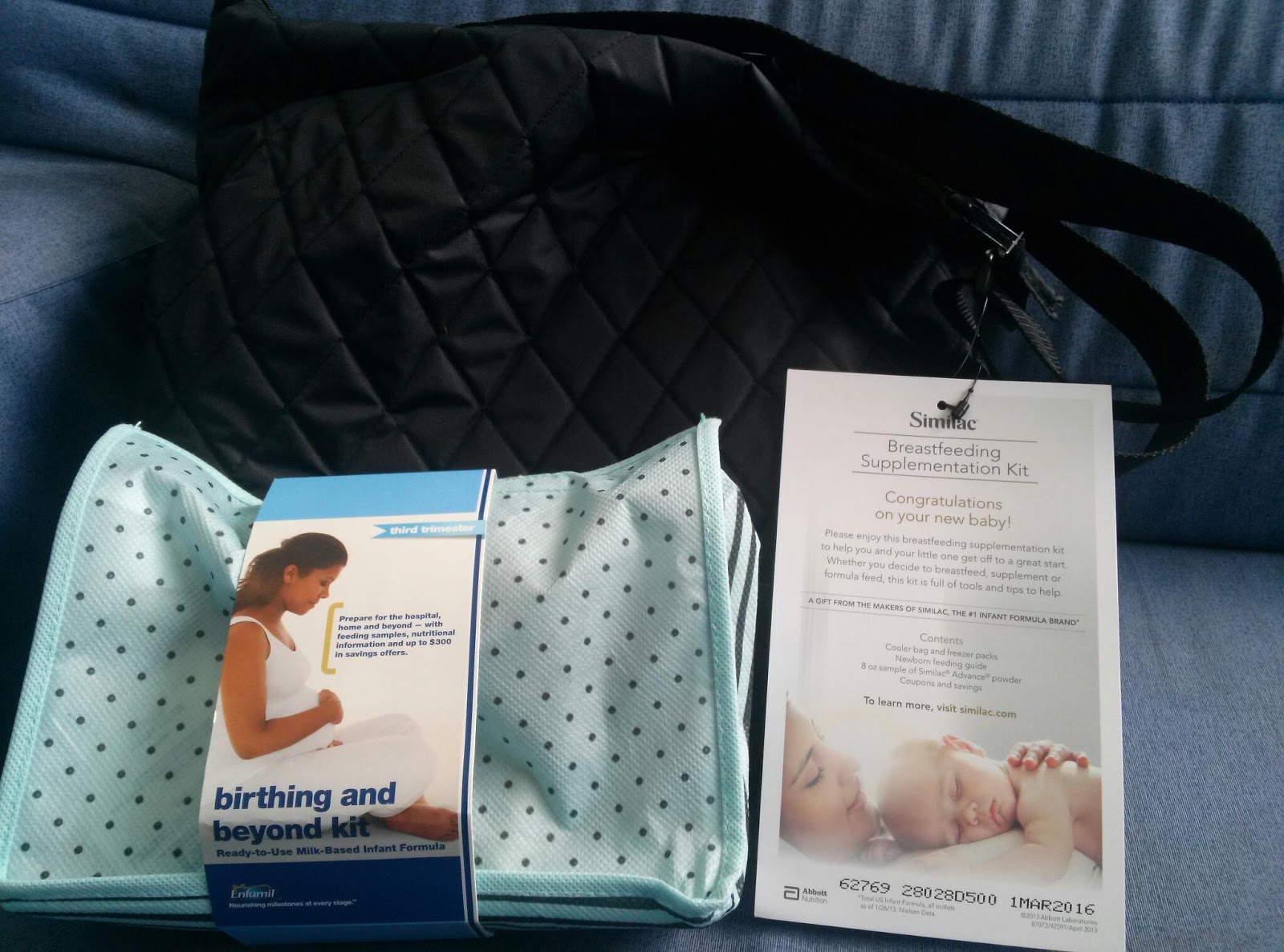
I know I personally won't be swayed by the formula marketing, since I have successfully exclusively breastfed two kids already and am extremely confident about breastfeeding this next little guy. I'm not worried that having some formula samples in my house will cause me any problems. I have a purely academic interest in what these bags contain and how their contents might be perceived by a mother less gung-ho than I am about breastfeeding.
I was not disappointed.


I'll start with the Enfamil package. It was a small, cloth bag fastened with Velcro. The label said it is a "birthing and beyond kit" and informed me that it contained ready-to-use formula. Inside were four "Nursette" bottles - two Newborn and two Gentlease - and one bottle nipple. Also included were a booklet on caring for my newborn, a book of coupons for various Enfamil products, informational cards about each type of included formula, and a postcard telling me that I could download the American Academy of Pediatrics' New Mother's Breastfeeding Essentials ebook from Enfamil's website.


The booklet, called "Your new baby - a detailed guide to your newborn's nutrition and well-being" contains a selection of generic advice regarding newborn care, milestones, and development, including a section on breastfeeding. This section is brief, not detailed, and is not complete enough to truly be helpful. They also find ways to advertise other Enfamil products such as their Vitamin D supplement, with a page on why supplementing with Vitamin D is important. The breastfeeding section is immediately followed by a section entitled "supplementing & formula-feeding," with the headline on the first page, "Going back to work - or just ready for a change." They then briefly discuss reasons why a mother might choose to supplement with formula, none of which are situations in which supplementation with formula is medically necessary: "milk was delayed coming in," "going back to work," "didn't feel like baby was getting enough," "mom or baby got sick," "baby had trouble latching or sucking," "pumping was too uncomfortable or inconvenient." This is followed by tips for bottle-feeding and preparing formula. The booklet also directs you to an 800 number or the Enfamil website for "live help."


I'll discuss all of this after we look at Similac's bag.

First of all, Similac's gifts were much more impressive. It starts with a quilted, messenger-sized shoulder bag which could be used for just about anything. It is simply black, with no Similac branding except for the large, removable label hanging from the strap. The bag is called a "Breastfeeding Supplementation Kit". In the bag were a sample-sized can of Similac powdered formula, a black cooler bag sized just about right for two bottles, with two Similac-branded ice packs inside, a Similac-branded booklet called "The Art of Feeding", a chart for how long breastmilk can be stored and instructions for use of the cooler bag, and a pile of coupons for everything from diapers to Disney movies. Surprisingly, none of the coupons were for Similac itself.


The first thing I want to draw your attention to is the absurdity of a formula company - any formula company - offering advice on breastfeeding. Take any of this advice with a grain of salt. While none of what they say in either booklet is precisely "wrong," it's also not the kind of detailed help a struggling new mother might need, and some of it is misleading or incomplete. By including this information, these companies are trying to look like they're being breastfeeding-friendly, while simultaneously giving new parents the "permission" they need to supplement or switch to formula rather than try to solve any breastfeeding problems they encounter. By "allowing" a mother to use formula in addition to (or instead of) breastmilk, they are presenting her with a guilt-free "get out of breastfeeding" card. And they offer no real advice about how to know when you actually need to supplement, how to avoid the need to supplement, or how to realistically combine formula and breastfeeding in a way that will not further harm your breastmilk supply. They also do a fine job of explaining why their products are "almost as good as," or "the next best thing to" mom's own milk, and they show a range of products to meet any baby's needs.
Why does all this matter?
Well, let's look at where I got these bags. Who gave them to me? My doctor. By giving me these bags, my doctor is implicitly endorsing my use of formula. She has not given me any information on breastfeeding, has not discussed my choice of feeding method, and has not asked if I need any help making such a decision. I'm seven weeks from my due date. Maybe I'm still on the fence about how I want to feed my new baby. Maybe I haven't even really given it much thought. Maybe I'm being bombarded from all sides by the internet, my family, and my friends about how I "should" do this or I "can't" do that. Maybe I don't trust my breasts and my body. Maybe I don't really "get" how breastfeeding works. Maybe I think it's "gross." Or maybe I have body issues due to psychological problems or sexual abuse and the thought of anyone touching my breasts, even a baby, is nauseating or panic-inducing. I now have a ready-made solution: my doctor gave me formula samples. If I have any doubts about breastfeeding, I now know that my doctor thinks giving me some formula "in advance," "just in case," is a good idea. And if my doctor thinks it's a good idea, who am I to question?
Now, granted, this is my fourth baby, and I've made it pretty darn clear with my doctor, in the short time we've known each other, that I know exactly what I'm talking about and that I have a very clear idea of what I'm going to be doing. So it may be that she sensed I don't need her advice. I don't know how she might be with a first-time mother, or even a second- or third-time mother who is considering breastfeeding for the first time. I may actually ask her at our next appointment if they do provide any prenatal breastfeeding support or advice. One thing I am comforted by is that I got two different brands' bags, so the office is not endorsing one over the other, and they just sort of threw them at me with a, "Oh, yeah, you can have these if you want" attitude. But I wasn't exactly discouraged from taking them, either. And the way it's presented, "Oh, and we have some goody bags for you, too!" makes it sound so exciting and exclusive! Of course I'd want a goody bag!
I'm very interested to see what, if anything, I get from the hospital, if this is what I got from the OB!
Breastfeeding simply can't compete with the formula marketing scheme. Sure, I could get a bag from Medela or Hygeia or Avent or Lansinoh with various breastfeeding accessories such as breast pads, lanolin, and freezer packs. But these companies simply don't have the market share that the formula companies do, and they don't have as vested an interest in gaining you as a customer. You'll never, ever spend as much money on breastfeeding as you would if you buy formula. You just won't. It's not worth it for their bottom line to give out freebies like it is for the formula companies. That leaves doctors and hospitals and midwives and bloggers and lactation consultants to do the leg work of educating the public about breastfeeding.
What it comes down to for me, with this blog and in my life, is this: I don't have any say in what you choose to do, how you choose to give birth, how you choose to feed your baby, or any other of the myriad choices you'll be making as a parent. But, I do care that you make those decisions based on good, solid, evidenced-based information, which is what I try to provide you with here on my blog and if you ask me advice in person or through my social media outlets. There is no disputing the fact that formula is inferior to breastfeeding. There is a time and a place for the use of formula, and I can even give you advice on how and when to use it in a way that won't sabotage your breastfeeding relationship, if you need such help. I hope - I really, really hope - that you won't turn to Similac or Enfamil or Nestle to tell you how to "successfully" supplement your breastfed baby with formula and think that the information they give you is truly accurate.
I know that these formula samples can be genuinely helpful in certain cases when short-term supplementation is necessary. But I also think there are ways to provide such samples to the mothers that need them, without essentially spamming every pregnant mother with something she probably won't need.
As for me, I'm going to keep my bags to use as an educational tool when I finally start teaching my own breastfeeding classes. Raising awareness of exactly what you're getting when your doctor hands you a "goody bag" is a necessary step toward improving breastfeeding rates and successes.
Did you receive formula goody bags from your OB, hospital, or pediatrician? What types of products did you get? How did you feel about receiving these freebies? Did you use any of the products?
Tuesday, July 30, 2013
Initial Impressions of My New Care Provider
I had been seeing a nurse-midwife at Kaiser for my prenatal care until last month, when we moved from southern California to the Bay Area. I had to find a new provider and hospital to go with my new location and insurance. Switching care providers mid-pregnancy, especially when you've been happy with your care and been with the same provider for two previous pregnancies, is difficult. I didn't know anyone in my new location whom I could ask for a recommendation. To some extent, I felt like I was basically (figuratively) letting the phone book fall open and calling whoever was on the page it landed on.
While I think I might have preferred to stick with the nurse-midwife route, I did take the step of asking on a parenting group I frequent if anyone was from the area and could help me choose someone and someplace. One of the hospitals here was highly recommended, and a perusal of the hospital's website made it look quite inviting. I looked at the hospital's list of OB providers and chose a group of nine OB's located just across the street from the hospital. Their office staff was friendly and helpful and sounded on the ball and competent. They explained that they assign each provider a certain number of patients who are due within the same month, and you stick with that provider throughout your prenatal care, and there's a very good chance she will be the one to deliver your baby. I liked the sound of that, as my previous experience with group practices was that you needed to meet everyone in the practice because they rotated call duty. She gave me the option of three of the doctors and I said I really didn't know any of them or have a way to choose, so she suggested one and made me an appointment.
I had that appointment a few weeks ago. The office was easy to find, right next to the hospital. A few things I was immediately on alert for. First of all, how busy was the office? It looked busy but not crowded. I saw no formula advertisements or paraphernalia (but no breastfeeding posters, either). They didn't seem to be running behind (I had a 10:15 appointment and was seen on time), and no one seemed to wait long in the waiting room before being called back. The billing office was very helpful in confirming my insurance and payment responsibilities.
The medical assistant who took me back was competent in taking my weight and blood pressure. The office used a regular doctor's scale and a hand-pumped and manually read blood pressure cuff. Kaiser always had fancy new digital equipment, and there was something charming and hands-on about doing it the "old fashioned" way. The MA wasn't sure if I'd need a gynecological exam, since I was farther along in my pregnancy and transferring care, but she had me undress from the waist down just in case. The stirrups on the table were covered with oven mitts, which I found very funny. I appreciated that they were covered - it showed respect for the patient's comfort - and I appreciated that they were not branded. (I've seen formula-company branded stirrups in other OB offices!)
The doctor herself came in promptly and was a sweet and personable woman. She checked the baby's heart beat and did a quick external ultrasound to take a measurement of his head, for her own records, since I had not yet obtained my records from Kaiser. She measured my fundal height and said I was measuring right on track. There was no mention of my weight gain (about 17 pounds so far), so I figured there was no concern there. She said she definitely wanted to hear about my history, but that we could do that in her office where we'd be comfortable (and I'd be dressed!), rather than sitting in the exam room. I really appreciated that!
I met her in her office, where she listened to my three previous birth stories and my concerns. She said I was obviously a good candidate for VBAC (this being my fourth baby and potentially third VBAC), and that her office and the hospital, and the nurses at the hospital, were very supportive of natural birth. She said she was on call mostly during the weekdays because she has two kids at home (in fact, she had just returned from maternity leave after having her second), and that there was probably a 75% chance that I'd get her as my delivery doctor. If she wasn't available, then one of the other doctors from the practice would be on call, and she of course trusted them fully to take good care of her patients.
Overall, I feel good about this doctor. I'll see what happens in the weeks to come (my next appointment is in about two weeks). She seems like she'll listen to me and respects that, hey, this is my fourth; I may know a little something about this process. She seemed to be willing to listen to my assertion that Pitocin and I don't get along, and that I really don't need it anyway! She was pleased and a bit surprised to hear that though I had blood pressure issues with my first two, I did not with my third.
Of course, I'll have a much fuller report once I actually deliver this baby! (Three months to go...)
While I think I might have preferred to stick with the nurse-midwife route, I did take the step of asking on a parenting group I frequent if anyone was from the area and could help me choose someone and someplace. One of the hospitals here was highly recommended, and a perusal of the hospital's website made it look quite inviting. I looked at the hospital's list of OB providers and chose a group of nine OB's located just across the street from the hospital. Their office staff was friendly and helpful and sounded on the ball and competent. They explained that they assign each provider a certain number of patients who are due within the same month, and you stick with that provider throughout your prenatal care, and there's a very good chance she will be the one to deliver your baby. I liked the sound of that, as my previous experience with group practices was that you needed to meet everyone in the practice because they rotated call duty. She gave me the option of three of the doctors and I said I really didn't know any of them or have a way to choose, so she suggested one and made me an appointment.
I had that appointment a few weeks ago. The office was easy to find, right next to the hospital. A few things I was immediately on alert for. First of all, how busy was the office? It looked busy but not crowded. I saw no formula advertisements or paraphernalia (but no breastfeeding posters, either). They didn't seem to be running behind (I had a 10:15 appointment and was seen on time), and no one seemed to wait long in the waiting room before being called back. The billing office was very helpful in confirming my insurance and payment responsibilities.
The medical assistant who took me back was competent in taking my weight and blood pressure. The office used a regular doctor's scale and a hand-pumped and manually read blood pressure cuff. Kaiser always had fancy new digital equipment, and there was something charming and hands-on about doing it the "old fashioned" way. The MA wasn't sure if I'd need a gynecological exam, since I was farther along in my pregnancy and transferring care, but she had me undress from the waist down just in case. The stirrups on the table were covered with oven mitts, which I found very funny. I appreciated that they were covered - it showed respect for the patient's comfort - and I appreciated that they were not branded. (I've seen formula-company branded stirrups in other OB offices!)
The doctor herself came in promptly and was a sweet and personable woman. She checked the baby's heart beat and did a quick external ultrasound to take a measurement of his head, for her own records, since I had not yet obtained my records from Kaiser. She measured my fundal height and said I was measuring right on track. There was no mention of my weight gain (about 17 pounds so far), so I figured there was no concern there. She said she definitely wanted to hear about my history, but that we could do that in her office where we'd be comfortable (and I'd be dressed!), rather than sitting in the exam room. I really appreciated that!
I met her in her office, where she listened to my three previous birth stories and my concerns. She said I was obviously a good candidate for VBAC (this being my fourth baby and potentially third VBAC), and that her office and the hospital, and the nurses at the hospital, were very supportive of natural birth. She said she was on call mostly during the weekdays because she has two kids at home (in fact, she had just returned from maternity leave after having her second), and that there was probably a 75% chance that I'd get her as my delivery doctor. If she wasn't available, then one of the other doctors from the practice would be on call, and she of course trusted them fully to take good care of her patients.
Overall, I feel good about this doctor. I'll see what happens in the weeks to come (my next appointment is in about two weeks). She seems like she'll listen to me and respects that, hey, this is my fourth; I may know a little something about this process. She seemed to be willing to listen to my assertion that Pitocin and I don't get along, and that I really don't need it anyway! She was pleased and a bit surprised to hear that though I had blood pressure issues with my first two, I did not with my third.
Of course, I'll have a much fuller report once I actually deliver this baby! (Three months to go...)
Subscribe to:
Posts (Atom)